Showing posts with label 2.5 stars. Show all posts

Thursday, April 23, 2015

The Last 3 Books Jamie Has Read

 Let's take a peek at the last 3 books I read! All of them were YA contemporaries (no surprise) and my reactions definitely varied!


The Queen of Bright and Shiny Things by Ann Aguirre


MAN, I wanted to love this one more. My lukewarm feelings for it are definitely in the minority so take that for what it is. I thought it was cute and felt the swoons for the romance (though it went from insta-attraction to insta-love REAL quick but I wasn't super bothered by it). I liked the main character Sage and her Post-It note kindness that she spread around school. And I liked the idea of her story -- a girl with a hard past trying to become this happy, bubbly girl as armor to shove down that old self -- but I just never really felt much more for it. I never felt that those cracks of her old self were really there. I think that's the whole of the problem...I wanted to feel more and didn't. One technical issue I had was with the pacing -- sometimes I was racing to devour it and other chunks of it I was skimming. By the time I finished I felt like the only thing I had to say about it was, "well that was cute?" Read my full review of The Queen of Bright and Shiny Things.

Rating: 2.5/5 stars


All the Bright Places by Jennifer Niven


Oh this was my book club pick and there was so much to talk about! This was one of the saddest books I've ever read by the end. The sobbing just kept happening to the point I had to put it down. It deals with two teens who both want to commit suicide so it's a pretty heavy book but it was balanced with the quirkiness of Theodore and the relationship he and Violet had. This was a book I had to really digest. I couldn't wrap my feelings around how I felt about it.  Overall I think I really liked it but I have some issues centering around it that I'm still mulling over and they would be very spoilery. It's one of those times though when the blurb ACTUALLY kind of nails it -- Fault In Our Stars meets Eleanor & Park. I would actually really agree with that but it totally does its own thing.

Rating: Ah I can't in good conscience rate it quite yet while I'm still mulling it over. I do recommend it though.


All the Rage by Courtney Summers


Oh this book is so important!! I wish I could require all young people to read it. What I love about Courtney Summers' books that shines here is the raw and unapologetic way she writes about important things. It's honest and it made me very very emotional -- sadness, a whole lot of anger, etc. It weaves a lot of important things into this story -- slut-shaming, victim-blaming, rape culture, feminism -- without being too heavy-handed and when combined with the mystery of what happened to Romy and Penny made it SO hard to put it down.  Read my full review of All the Rage.

Rating: 4/5 stars


Have you read any of these? What did YOU think?

Monday, October 7, 2013

Tahleen reviews: "A Plain Death" by Amanda Flower

A Plain Death (Appleseed Creek Mystery #1)Title: A Plain Death
Author: Amanda Flower
Publisher: B&H Publishing Group, 2013

Rating: 2.5 stars

Chloe has accepted a new job at the head of IT at a small liberal arts college in Appleseed Creek, Ohio. She is not thrilled to be taking the position in such a small town in the middle of nowhere, but it was the only job offer she received and she needs the experience. But on her way into town, things get interesting fast when she picks up an ex-Amish teen who's being harassed by some unsavory guys in a truck. The girl, Becky, latches on to Chloe and manages to get Chloe to agree to let her be her new roommate; but things go downhill quickly when Becky borrows Chloe's car without asking (and without a license) and accidentally kills the local Amish bishop. It soon becomes clear that the car was tampered with and someone meant to harm Chloe. But who, and why?

I wasn't in love with this mystery, but I think the series has promise. A Plain Death lies somewhere between a thriller and a cozy mystery; there is real danger and an unknown assailant willing to do whatever it takes to get to Chloe and Becky, and we're not sure why they are targets until we get deeper into the mystery.

The writing was a bit clunky at times, and I don't think I ever really warmed to Chloe as a main character, but it seems as if she'll be the narrator in the future volumes in the series. There is a little romance between Chloe and Becky's older brother Timothy (also ex-Amish), which was nice, but there was a little something missing for me in that relationship.

I'm not sure I'll continue on with this series (FYI it's got some Christian messages in case that's something you like/don't like), but if you enjoy Amish fiction and mysteries it might be worth checking out.

Disclosure: I received an e-galley from the publisher via NetGalley in exchange for a review.

Friday, August 9, 2013

Kelly reviews "The White Princess" by Philippa Gregory + giveaway!

Title: The White Princess
Author: Philippa Gregory
Published: Touchstone, July 2013

I received a copy of the book from the publisher in exchange for an honest review.


The White Princess is fifth in The Cousin's War series revolving around the Plantagenet family. I read this series in the completely wrong order: book one, two, five, four, and then three. This would usually drive me nuts but I'm pretty familiar with this time period so it all still made sense. The latest release revolves around Elizabeth of York, King Edward IV's oldest daughter. Historically, we know her most famously for being the mother of Henry VIII, yet there aren't really many books that center around her, so this was exciting to pick up. Philippa and I have had our struggles in the past, but I still keep coming back for more.


In the series, we've left off right after Richard III is killed and Henry VII takes the throne. Elizabeth knows she comes as part of the package in Henry's ruling of England, but of course she's not eager to marry the man who stole her family's throne and killed her uncle. Henry certainly isn't a pleasant man in the beginning (aka he's HORRIBLE; what an awful portrayal of a pretty decent guy in reality), especially in his treatment of Elizabeth, but they eventually grow into somewhat happy pair. With a childhood spent in hiding, most of her family members meeting tragic ends, an unwanted husband, a rocky time as Queen, and the loss of many of her children, Elizabeth had quite an interesting life, but we don't see much of it in this book. She's pretty clueless throughout the entire thing (she says "I don't know" at least 400 times and most of her dialogue is her simply repeating what was just said previously) and at times I felt her character was underdeveloped and that she was simply observing things around her rather than participating in them (boooringgg).

Now I think Philippa Gregory writes wonderful fiction full of action (okay, not so much in this one), intense characters, and vivid scenery and life, but I don't like how she pushes many of her speculations as historical fact and her tendencies to make things over-dramatic simply for the sake of a good book rather than historical accuracy (as if this period of time wasn't dramatic enough). For instance, there's a BIG plot in The White Princess that Elizabeth was her uncle Richard III's lover (NO NO NO NO). There is only one tiny shred of historical evidence pointing to this and it's awkward to push this so heavily in a book (it's also a big point in the television show based on the series as well). Gregory's focus on Elizabeth and her female ancestors being descendants of a water goddess and consequentially sorceresses, if that's the right word, themselves is cool to an extent but mostly made me want to face-palm the entire time. The constant 'prophecies' Elizabeth kept relaying felt a little over the top - ("our family line will end with a red-headed girl," yeah yeah yeah). Still, I've enjoyed this series so far for what it is - "historical entertainment" (heavily twisted and imagined fiction as well). This was a good addition, even with a little debate and eyebrow-raising moments along the way - just don't take anything too seriously.

Giveaway! I have a beautiful hardcover copy of The White Princess to give away to one of you! US residents only - simply leave a comment below by August 16th to be entered.


Wednesday, July 31, 2013

Julia Reviews The Ocean at the End of the Lane by Neil Gaiman

Title/Author: The Ocean at the End of the Lane by Neil Gaiman
Publisher/Year Published: 2013 by William Morrow Books
How I got this book: I borrowed it from a friend
Why I read this book: We have a book club at work and this was the July choice!
Rating: 2.5 stars

Summary: via Goodreads
Sussex, England. A middle-aged man returns to his childhood home to attend a funeral. Although the house he lived in is long gone, he is drawn to the farm at the end of the road, where, when he was seven, he encountered a most remarkable girl, Lettie Hempstock, and her mother and grandmother. He hasn't thought of Lettie in decades, and yet as he sits by the pond (a pond that she'd claimed was an ocean) behind the ramshackle old farmhouse, the unremembered past comes flooding back. And it is a past too strange, too frightening, too dangerous to have happened to anyone, let alone a small boy. 
Forty years earlier, a man committed suicide in a stolen car at this farm at the end of the road. Like a fuse on a firework, his death lit a touchpaper and resonated in unimaginable ways. The darkness was unleashed, something scary and thoroughly incomprehensible to a little boy. And Lettie—magical, comforting, wise beyond her years—promised to protect him, no matter what.
I have read one other Neil Gaiman book in my life (The Graveyard Book which I loved), and I think it is important for me to start there. The problem with Gaiman is that is he super awesome and famous (a rough problem to have I guess) but it gives these high expectations to his books. I really liked The Graveyard Book and I've checked out Stardust for a car ride later today, but I just could not connect with The Ocean at the End of the Lane.

My favorite quote from book club was that this book at the same time felt too long yet underdeveloped. There were times I wanted to know more (everything with the Hempstock family) and times where I just didn't think anything was happening. It has this strange story like feel to it where you kind of expect something to be left up to the imagination, but I think the wrong parts were.

There were times in this story where I was quite freaked out (the nanny) and other times where I was enchanted (the kitty). But overall it has the feel of a short story stretched out into a novel, though it still only clocks in at a hundred fifty pages and some change.

If you are new to Gaiman, I would not recommend this be your first book. If you are a fan, you may like this. If you need a book for book club, I will say that this was a book that had a lot of different reactions that were really interesting to talk about. It ran the gamut on if people loved it or hated it and sparked really interesting discussion points. So I guess it is up to you if you want to take an afternoon to read this. Based on the reactions though, I would get it from the library first :)

Questions for Gaiman readers out there, what would you recommend be the first book in his back list for new readers to try? I'd say the Graveyard Book (since it is the one out of two that I've read and liked).

Wednesday, May 8, 2013

Julia Reviews Destiny's Embrace by Beverly Jenkins


Title/Author: Destiny's Embrace by Beverly Jenkins
Publisher/Year Published: 2013 by Avon
How I got this book: I got this from the library
Why I read this book: It was the FIRST time I got a Smart Bitches, Trashy Books bookclub book and had time to read it before the book club AND wasn't busy during the live chat!
Rating: 2.5 stars

This was my first foray into Jenkins' work, and it wasn't too bad. I just didn't fall in love with the writing or the characters really (except Alanza, the hero's step-mama) and when you have a love story where the character's development drives the plot like it does here, and you don't enjoy the characters, it makes it a rough read. 

Let's SCORE it.

The Story:
It's the 1860s (ish), Mariah is a women pretty much working as a slave to her mom in a dress shop in PA. Something finally pushes her over the edge and she leaves for the safety of her aunt's house, and finally to the new life in California. She goes there, lying about being a widow (lol I almost wrote window), so she can get a job as a housemaid. 

Her job is with Logan, a rancher in California who lives with his (awesome) Spanish step-mom breaking in horses and making the women love him with his looks. From there the story moves to focus on their love and how it develops. Over three days.

The story was okay. It wasn't my favorite because I like a little more conflict. It seemed like the characters overcame their obstacles with too much ease for it to be believable. I wanted more tension, more turmoil from Mariah over stepping outside the bounds of housekeeperhood or with Logan realizing that he may want to marry her, an institution he had actively avoided until that point. Since this is primarily character driven, let's look at them.

The Characters:
Mariah is the lead and she goes from meek mouse who lived under the thumb of her mom for 30 years to spitfire in the course of a cross-country train ride. I liked that she had spark, but the transition was hard for me to believe. No matter how much you want to change yourself when you have the opportunity, old ways still seep in. I have experience with this (I've not been trapped in a workhouse for 30 years though). 

Outside of that Mariah is a pretty strong woman. I loved she didn't get clingy to the hero. She was very much there to do her job and find her life. 

Logan was a little more well rounded from the beginning. His only flaw was that he breaks hearts and didn't want to settle with a woman. And that's all he had to grow from. His other character traits include, grumpy and stubborn (which was really fun to read when he and Mariah butted heads), friend to the natives and wanting Mariah. Not my favorite hero, but he was never a jackass. 

The secondary characters were pretty cool, Alanza (the MIL) leading the charge. She was a spitfire ranch lady. She was Logan's stepmom, and I loved that there wasn't that "She was my evil step-mom" storyline from either Alanza or Logan. That was refreshing.

One thing I have to say that was probably my favorite part of this was that the cast of characters contained so much variety. Spanish, African-Americans, Native-Americans. Loved that. And I want to seek out more of these.

The Romance
Eh. I liked when they were fighting with each other. I love sparks flying. And I also loved, like I said, how Mariah didn't get clingy after the sexin'. But overall I was a little cold with the romance. It was just okay for me.

The Execution
This is where it probably loses most of the stars for me. The writing just seemed so cliched at times. The euphemisms drove me up a wall. The whole story itself was rather hurried, in writing and time in the story. The thing took place over a week. I think I would have liked it more if they took their time with the romance. I know it's the west, but I don't know it just took me out of the story. The other thing I had previously mentioned was the seeming lack of consequences. Everything just flew by too perfectly.

The Overview
I can see why people like it. Really, I can. It reminds me of this one series I read based around a family of eight kids in Texas. But it just didn't work for me. I liked the history laced within, and I liked some characters, but overall it just wasn't my cup of tea. It wasn't horrid, just meh. Hence the two and a half stars. 

If you want something light that has some interested sparks of history, that flys by fast and "treasures between her legs" don't bother you, check this out. I don't think I will continue this series, but I may try another one of the author's books. The multicultural aspect and finding a historical that isn't set in England are enough reasons to try again.

Friday, November 23, 2012

Book tour: "The Gilded Lily" by Deborah Swift + giveaway

"England, 1660. Ella Appleby believes she  is destined for better things than slaving as a housemaid and dodging the blows of  her drunken father. When her employer dies suddenly, she seizes her chance--taking his valuables and fleeing the countryside with her sister for the golden prospects of London. But London may not be the promised land she expects.  Work is hard to find, until Ella takes up with a dashing and dubious gentleman with ties to the London underworld. Meanwhile, her old employer's twin brother is in hot pursuit of the sisters.
Set in a London of atmospheric coffee houses, gilded mansions, and shady pawnshops hidden from rich men’s view, Deborah Swift's The Gilded Lily is a dazzling novel of historical adventure." (from goodreads)


Hosted by Historical Fiction Book Tours
Twitter hashtag: #GildedLilyVirtualTour
Publication date: November 27, 2012

It's always a little awkward reviewing a book which you don't completely trust your feelings about. A part of me loved The Gilded Lily. Another part of me hated it. The parts I loved were Sadie and Dennis, two very  kind, and misunderstood kids fighting to survive. These two are literally the only two likable characters that you will root for, maybe excepting one girl that Sadie works with, the only girl who shows her kindness. I loved the time period. England in the mid-1600s was a pretty odd place. The government and its people were unstable from civil war and an odd mix of the filthy rich and dirt poor - we see both extremes in this book. It was interesting reading about the harsh working conditions/options for girls in this time period.

I did NOT like Ella. Or Jay (the "dashing and dubious gentleman" described above). Or any of Jay's friends. Or his father. Or Ella and Sadie's boss. Everyone was sinister, a murderer, two-faced, or just a plain jerk.  I've never really read a book that contained so many characters I disliked. I also spent a majority of the time just waiting on something, ANYTHING, to happen. What you read in the summary is basically what more than three-quarters of the book was actually about. I don't like reading 200 pages of a book and still questioning what the actual plot is. FINALLY, we get some action and a climax at the end of the book....but it's really dark and a little terrifying.

I came away from The Gilded Lily feeling really depressed. You can practically feel the dreariness of London upon you as you read. Ella's horribleness rubs you the wrong way. The rank living conditions make you feel unclean. Reading about Ella and Sadie's close encounters with the law puts you on edge.The smarminess of Jay and his creepy friends makes you uncomfortable. I must say the the ability to produce this many real emotions shows a great writing ability, and I really did like the writing style and 17th century dialect, but leaving a book feeling used and violated isn't ideal.

Giveaway
Never fear! You have the chance to form your own opinion about The Gilded Lily! I have a review copy for one of you. The giveaway is international and open until the 30th. Enter HERE, good luck!

Wednesday, September 26, 2012

Bridget Reviews The Age of Miracles by Karen Thompson Walker


Title/Author: The Age of Miracles by Karen Thompson Walker
Publisher/Year Published: 2012 by Random House
How I got this book: Random House sent me this book for review.
Why I read this book: A free copy was offered to TBTB for review and I claimed it!
Rating: 2.5/5

The Age of Miracles tells the story of twelve-year-old Julia, who wakes up one morning to discover—along with the rest of the world—that the Earth’s rotation has begun to slow. As both the days and nights grow longer, the gravity and the weather are not the only things to be affected: Julia must also deal with the societal implications as well as the effects on her own family and friends.

I really wanted to like this book. I love science fiction, and the plot sounded incredibly creative. I also love a good bildungsroman, and from the description I got from Random House as well as the book flap, it seemed like it would be a great story about growing up in a crumbling world. Unfortunately, it seemed a bit to me like Walker tried too hard to make it both without putting enough substance in the story.

It just seemed to me like there were far too many loose ends. Early on, eleven-year-old Julia is sexually harassed at the bus stop by an older boy—and nothing at all comes of this, other than the fact that she loses a beloved necklace that is mentioned maybe one or two more times. Later, Julia’s friendship with her best friend Hanna collapses unexpectedly, with no resolution. I realize that this can happen to relationships, but it felt like it happened for no reason. After Julia turns twelve, she is invited to a small party in one of the wealthier neighborhoods, where she and a few other young teenagers drink beer—and again, nothing at all comes from it. Frankly, it seemed less like an actual plot than a series of random events, loosely strung together against the backdrop of the inexorable slowing of the Earth’s rotation.

I was also hoping to see some more of Julia’s actual growing up, but the only birthday she passes in the entire book is her twelfth. She’s much older in the last chapter/epilogue (at least 23), but most of the blanks between her twelfth year and her twenty-third are left unfilled. I think the story would have flowed a little better if it had taken place over more than a year.

I’m the type of person who likes long books that I can lose myself in—books where I can really get to know the characters and get involved in the story. At only 269 pages, this was not one of those books. It felt rushed and disorganized to me, despite the very promising plot, and I think that if she had explored some of the incidents I mentioned above a bit more, she could have written a much better, more coherent story.

Rating: 2.5/5 stars

Friday, July 13, 2012

Tahleen reviews: "Death Comes to Pemberley" audiobook by P.D. James

Title: Death Comes to Pemberley
Author: P.D. James
Publisher: Random House Audio, 2011 (print available from Knopf)
Narrator: Rosalyn Landor

Rating: 2.5 stars

Taking place a few years after the ending of Jane Austen's Pride & Prejudice, enough time for Darcy and Elizabeth to have a couple of sons, the main plot of Death Comes to Pemberley deals with a murder on Pemberley property, and the suspect is none other than... DUN DUN... GEORGE WICKHAM. However, Darcy and Elizabeth are convinced Wickham couldn't have possibly committed the heinous crime of bludgeoning his best friend (whose name is escaping me right now) to death. They are faced with a mystery, with the outcome being life or death for Wickham.

If this were just a mystery set in early 19th-century England, it would not be that bad. It was a decent mystery, and the outcome was not obvious. James did her research on the period, too, so it seems genuine. The writing is good, but my biggest problem with the novel was the characterization. I understand it's difficult to try to continue a story that is so deeply ingrained in our literary consciousness, but I found it hard to believe I was reading about the same characters in Austen's novel. I felt James took liberties with the characters, which is understandable considering the fact that she is writing a new story, but being such a fan of the original I was not impressed with the outcome.

Rosalyn Landor was a good narrator. Nothing remarkable, but she had a proper British accent that fit the story well.

If you like Georgian-era novels and mysteries, you might enjoy this latest P&P sequel/continuation/whatever you want to call it. If you are a purist and don't like anyone messing with your Austen, I would just move on.

Disclosure: I got this audiobook from the library.

Thursday, September 8, 2011

Tahleen reviews "Ashes, Ashes" by Jo Treggiari

Title: Ashes, Ashes
Author: Jo Treggiari
Publisher: Scholastic, 2011

Rating: ★★ ½

In a world that doesn't seem to be too far into the future, global warming has melted the ice caps and most of the coastal world is now underwater. This wasn't such a big deal for Lucy at first, since she was fine in her New Jersey town, but three years later an even deadlier enemy claimed 99% of the population of the planet: the plague. Lucy somehow managed to survive without contracting the disease at all, but her family was not so lucky. After a year of wilderness survival on her own in the Wilds of what used to be Central Park, Lucy finally finds a group of people who she might be able to live with. But she could spell the end for them all; there is something about her that makes her very valuable to those who are barely holding on to power.

While reading Ashes, Ashes, I often found myself thinking how awful the lives these people led sounded. I was very creeped out during the beginning of the book, when Lucy was still on her own, but I kept flipping the pages, eager to discover Lucy's past and what would happen next.

I didn't find out much as far as back story, unfortunately. We learn that Lucy is largely unremarkable, with no special talents other than survival. I can tell there is more to her, but I never found her history besides brief flashes of memory, which was disappointing for me. The same is true for the secondary characters in this book—we get clues, but no real stories.

What didn't disappoint was the action. There was a lot of it, and Lucy was nearly always at the center of it. I was compelled to find out the mysteries behind the Sweepers, what I'm assuming are government officials who kidnap survivors of the plague. Those kidnapped are never seen again. And when Lucy becomes their target, I wanted to know what made her special.

The next part might be a bit spoilery, just a warning. We never really get the answers to the burning questions in the book, kind of a letdown, especially when much of the book focuses on this aspect of Lucy and how the Sweepers are after her for some reason. I'm guessing there will be a sequel to answer some of these questions.

Overall, I don't feel strongly about this book one way or the other. It provided entertainment while I was reading and did give me something to think about as far as how the way we are treating our planet might turn out, but I don't think the story or the characters will stay with me too long afterward. If a sequel does come out, I will most likely pick it up to find out the secrets behind the characters and the government that were left unrevealed in Ashes, Ashes.

Disclosure: I received an ARC from the publisher at one of their events.

Wednesday, June 1, 2011

Natanya Reviews Life...With No Breaks


Title/Author: Life…With No Breaks by Nick Spalding
Publisher/Year: Racket Publishing, 2010
Where I got it: Amazon, for my Kindle
Why I read it: I for some reason downloaded a sample of it at some point, and I liked the sample enough to shell out the $3 for the full book

From Goodreads:
"I'm Nick Spalding and I had an idea. What if I tried to write a book about life...with no breaks? An entire book, in one go. Could I do it? And how would it turn out?"

Join author Nick Spalding as he wends his merry way through an odyssey of non-stop writing, covering a variety of subjects in a selection of riotous anecdotes, comedy asides and humorous stories...dredged up from a brain functioning on caffeine, nicotine and the occasional chocolate biscuit.

The book is written as a conversation with YOU, the reader...and with Nick you'll venture into the thorny topics of love, life, death, sex, money, horribly timed bowel movements and a deathly fear of sponges (amongst other things).

After finally actually buying a book from the Kindle store (up until now I’d refused to actually pay money for e-books), I was hoping to be in for a fun adventure. Spalding’s book starts out funny and witty, with a crazy story from a time he was drunk, and continues for the rest of the book as a series of random stories and musings. He suddenly goes off on tangents, which I often enjoyed, and these topical shifts are not too sudden, so it does work. His storytelling manner is humorous and not too drawn out, making his stories easy to read, and I liked how he addressed the reader directly, pretending like the reader is sitting there next to them. For the first third or so of the book, I was thoroughly amused.

But by the time I got halfway through, I wasn’t entirely sure why I was still reading it. While the beginning was funny, the book got kind of boring after that. I guess it’s because I’m not accustomed to reading books with no plot. This book really is a series of tangents, rambles, and musings, which Spalding wrote down as he thought of them over the course of the 30 solid hours in which he wrote this book. Because of this, the reader has absolutely no idea what he will talk about next, which meant that I didn’t have any real motivation to continue reading—I didn’t have any reason to care what happened later.

Furthermore, Spalding occasionally veers off from his storytelling into ramblings on things like religion or advertisements, and his thoughts on those are pretty typical—he doesn’t provide many new or interesting insights, but instead just restates some of the usual complaints in a slightly funnier manner. His stories are definitely better than these parts, and the funniest stories are generally the ones having to do with sex or alcohol, like his depiction of the awkwardness of losing his virginity. However, even the stories didn’t all hold my attention for long, which I think may in part be due to my inability to relate to some of them. As a whole, the book is pretty easy to relate to, but his discussions of certain aspects of life, like becoming a father, were things that aren’t relevant to me, yet he presented them as if I was supposed to be going through the exact same thing.

On the whole, I can best relate this book to an extremely long blog post, in which Spalding rambles on about many different aspects of his life. While a number of instances in the book are legitimately funny, others seem forced or just not interesting enough topics to be worth discussing. I do understand why some people may like this book, but for me, it wasn’t worth it. It wasn’t funny enough to hold my attention for long and, for a short book, it just went on and on (especially at the end). It wasn’t horrible, but was just…blah.

2.5 stars

Friday, April 15, 2011

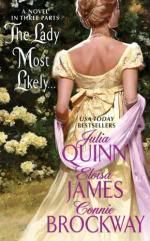
Julia Reviews The Lady Most Likely

Title/Author: The Lady Most Likely by Julia Quinn, Eloisa James, Connie Brockway
Publisher/Year Published: 2010 by Avon
How I got this book: the library
Why I read this book: It sounded interesting and Julia Quinn and Eloisa James are on auto-read.
Rating: 2.5 stars

The Lady Most Likely was marketed to me heavily on Facebook. It was toted to be "a novel in three parts". What these authors decided to do was to have a powwow, come up with a general story and have each write a section: beginning, middle and end. Sounds quite intriguing. Could they pull it off? Would the hero act the same in part one as he did in part three? How would the inner monologues change between the three sections? I was quite curious.

Unfortunately, when I started reading “the middle” I realized that it really wasn’t a novel in three parts but an overlapping anthology. Each “part” had its own mini-romance all centering around a house party in the country. Time wise they interacted and overlapped, but you can tell the focus shifts with each author.

I think I had really high expectations for this going in. I thought it was going to be something awesome: one main romance told round robin style. I must confess. When I was in high school, we had something called “The Notebook.” Three of my friends and I would each take turns writing a few pages in a narrative. It was so much fun, because not only would you get to read about what the last three people had done with the story, but you got to take it in a whole different direction if you wanted. (Cool story sis time: It was freshman year when we did this using an actual notebook. Some other of our friends got jealous of us, stole the book and ripped it up in front of us. Or maybe we felt bad and ripped it up so they would feel better. I don’t remember. All I do know is we moved to emails. I still have them)

The downfall of our story was that we had the most basic of beginning storylines, with each having a character to call our own. The stories never got anywhere and things sort of died off. I figured what we lacked in experience of ours would be rectified in these three awesome authors coming together to create a story.

It just didn’t work for me. They should have just called it an interlinking anthology and then maybe I would have felt better.

Outside of the premise, the story was just okay for me. It is hard for me to like romantic short stories because everything seems too rushed and unbelievable for me. (And I already suspend enough reality as it is.) These are great authors, I just don’t think that this work best exemplifies who they are. I would recommend it to someone who wants some quick, light romance.

Wednesday, March 23, 2011

Tahleen reviews: "Angelfire" by Courtney Allison Moulton

Title: Angelfire
Author: Courtney Allison Moulton
Publisher: Katherine Tegen Books (HarperTeen), 2011
How I got it: The publisher provided a copy in exchange for an honest review.

Rating: ★★½

Ellie considers herself to be a normal girl, nothing too out of the ordinary. She is not the best in school but tries her hardest, has a group of close friends, and enjoys going out and having fun. But she has been having the strangest nightmares for weeks, and there's a strange guy hanging around her school who seems interested in her. Then, on the eve of her 17th birthday, her worst  nightmares come to life.

It turns out she is the Preliator, the biggest defense Heaven has against Hell. She is destined to hunt reapers, monsters that drag human souls to hell, a job she has had for centuries and has died for countless times, always coming back in another life. The strange tattooed guy she's been seeing around her school is her Guardian, Will, who has known her for 500 years. But it seems like this life, as Ellie, is different from her past ones; according to Will, she is more human than she has ever been, and she is having a harder time remembering her past lives. Plus, a deeper evil exists that could to destroy Ellie forever—if it awakens.

The concept for this book is a good one. Mystery surrounds Ellie, her past, and what she is, something not even Will is sure of. She can destroy demons with an awesome set of blades that can light on fire (angelfire, a special kind that won't burn anyone except demonic reapers) when she wishes it. There is forbidden romance. On paper, it looks pretty good, but the execution was not particularly spectacular.

Despite the book's length (the ARC has just over 450 pages), I felt like there was too much crammed in too fast. Much of the worldbuilding was done through dialogue via Will, though Ellie would have the occasional flashback, which I wish there had been more of. Those were much more interesting than listening to Will explain everything. It's clear Moulton knows her world well, but it all felt rushed and confusing.

The writing was a bit clunky, as well. There were a lot of cliches, and certain phrases and words were used far too often, especially "my heart sank," and there was a lot of perking up and scoffing going on. It got to the point that I winced whenever I saw one of those phrases.

There was a lot of materialism in the book, in the form of consumption and name-dropping, especially with cars, that seemed very out of place. Ellie comes from wealth, as do her friends, and this is made abundantly clear throughout the book. The gross consumerism was just a hair shy of the fantasies that can be found in series like Gossip Girl and Blue Bloods—the consumption in those books are deliberately over the top and fun to read about, but here it just seemed unnecessary and forced.


Some people will find Ellie and Will's relationship romantic, especially fans of forbidden paranormal romance. Though I found it tiring and got bored with the long descriptions of how Will looks and the way he makes Ellie feel, I'm sure there will be at least some swooning over Will by others.


But despite all the negative aspects of the book, it was certainly a page-turner. There were a lot of action scenes that kept me interested, and the mysteries of who each character might be made me want to keep reading to find out what I could.

Overall, I don't think there is anything particularly special about Angelfire. It's a typical paranormal romance with a mixture of folklore, mythology and Biblical influences. The action makes it a page-turner, but I found myself skimming and not missing a whole lot. I'm not sure I'll pick up the sequels, but this book will find a number of fans because of its inclusion in an increasingly popular subgenre.

Wednesday, January 5, 2011

Julia Reviews " Outlander" by Diana Gabaldon

Title/Author:Outlander by Diana Gabaldon
Publisher/Year Published: 1991 by Dell
How I got this book: The Library
Where I got it: The library because everyone and the mother's half-cousin's maiden aunt twice removed had read it and loved it
Why I read this book: Everyone was recommending it to me. Thought I'd see what the fuss was about.
Rating: 2.5 stars

I read this back in June 2009. This is what I wrote right after finishing
You know I started off liking this book. I really did. Even at 200 pages in I was still enjoying it. But then something happened and it started to lose its "magic." It's been a while since I actually read it but I remember the feelings of "What?" and "I am pretty sure I could have conveyed the exact same feeling/thing in about 20 less pages" pretty well.

I think it started near the climax. It was done acceptably well. "Now lets get to the wrapping up part. What? There are still 200 pages? What the hell happens there? "

One of the things I really hate when reading is a book that goes on and on after what is clearly the climax (my biggest problem with Kite Runner as well). I mean, there were some interesting parts that happened after, but since this was already going to be a series, why not just move it over a book and end it with the reader feeling invigorated and not thinking "End already!"

I feel like I am in the minority in the dislike of this book. Clearly, some people must like it or Gabaldon wouldn't have the following she does nor would there be six or so succeeding books. And going back to some notes I took while reading it, I was enjoying it. But I have this feeling that if I pick up the next books in the series, I will hate myself.

So in conclusion. It was OK. Just OK. Maybe a good. An OK and a half. Will I be picking up the next books in the series? Unlikely. I feel like there are better books in the world that I can spend my time reading.

Overall, I still feel the same way. I just don't get it. Well, I get it more than I get Twilight but that's a whole different can of worms. It has time travel, love, action, interesting characters (when they are not being ridiculous). It has a lot of things. Actually, it has a lot of messed up things as well that really made me think, "I can't believe that just happened!"

I realize I have a inherent vendetta against long books, long defined as plus 500. If I feel it can be cut, I don't want it in there. I like plot driven by well rounded characters. At 800+ pages, this has fallen into my "too long!" box of no. I probably would have given the second book the good college try if it wasn't for that pet peeve. I have liked long books before (eg The Brothers Karamazof, Gone With the Wind, Harry Potter and the Half-Blood Prince, Three Musketeers) but I think I judge them harsher than I would a shorter novel.

How about you? What is your feeling on long books? Skip/Skim/Savor?

As for Outlander? I'm giving it a 2.5 only because there were parts I genuinely enjoyed.

Wednesday, December 1, 2010

Everything Is Going to Be Great: An Underfunded and Overexposed European Grand Tour

Everything Is Going to Be Great: An Underfunded and Overexposed European Grand Tour Title/Author: Everything Is Going to Be Great: An Underfunded and Overexposed European Grand Tour by Rachel Shukert
Publisher: Harper Perennial 2010
How I got this book:  Sent to me by the awesome people at Harper Perennial
Why I read this: I'm obsessed with travelogues and was so excited because it about a girl who was a recent college grad and I figured I'd be able to live vicariously through her as a recent college grad myself!
Rating: Between 2.5 stars and 3.

This book and I had a love/hate relationship. I started this book and found myself loving it and then I hit a chunk where I wanted to fling at the wall and abandon it and then I got to a place where I didn't loathe it and then I found myself really enjoying it again.

I think that the subtitle is a little misleading. I had such high expectations for this being a travelogue lover. This was more a series of hilarious sexcapades in 2 countries rather than a "European Grand Tour." I was so excited about this book because I felt like Rachel and I were kindred spirits and that I'd connect with her plight--being a college grad, not knowing what you want in life, wanting to see the world and just generally being broke and wanting to find yourself. She was all that but I just didn't find myself connecting with her until maybe the end.

Let me tell you some GREAT things about this book: Rachel is hilarious and the girl can write! I was seriously laughing out loud and dying with some of her descriptions of people and things. I'm impressed by her ability to make something otherwise not that exciting or amusing become something that makes me snort iced tea out of my nose. I also appreciate how honest she is about herself. I connected with that. At first, I found myself rolling my eyes at her and not caring about her because I just thought she was selfish and never learning and growing, but I found myself gaining alot of respect for her and genuinely finding her to be likable. I also thought she was clever in adding all these hilarious "extras" like when you are reading a travel guide and it might have a little boxed off section for things like "how to order food or what to do at the airport." Instead, her "extras" were things like "Assembling Your Rachel Shukert costume" (with a full on diagram about the "tuck method if you are a male" or "Are You About To Be Sex Trafficked?". Really clever and hilarious sections.

Things I Didn't Like/Feel The Need to Warn You About: If you are the least bit offended by explicit sexual details or lots of vulgar language, skip this one! I wouldn't consider myself a prude but sometimes felt shocked or embarrassed by the details. This book can be raunchy, vulgar and she loves to describe and talk about male anatomy in great detail--chocolate ones, big ones, little ones, uncircumsized ones--penises all over the globe! Also, I didn't find myself DYING to pick this up. I was trying to finish it during Readathon because I needed the motivation to do it. I got tired of her sexcapades after a while but I will say that in the end she does redeem herself a little bit.

The final thought: In the end I was pretty disappointed with this book as whole. I'd recommend going into it without the expectation that it will be the travelogue of a college grad. Read it if you wished David Sedaris and Chelsea Handler had smart assed, hilariously hip child. Don't pick this book up if you will be offended by sex and foul language. It's not that this book was BAD by any means..I just didn't enjoy it as much as I thought I would.

Here's a 4 star review from Leeswamme's blog to check out so you can have a more balanced opinion.

Monday, September 6, 2010

"Incarceron" by Catherine Fisher

Incarceron (Incarceron, Book 1)Title: Incarceron
Author: Catherine Fisher
Publisher: Dial, 2010
Where I got it: I borrowed it from the library.
Why I read it: I like reading the new dystopian stuff, and this was new and dystopian. Plus I had the time to read it.


Rating: ★★½ 


Here, there are two worlds. There is the Outside, where the people are slaves to Protocol—sticking to the technology and practices of an Era of old, of what seem to be Medieval times. And the other is Inside—within the living walls of Incarceron. Incarceron is a prison that lives and thinks, watching the thousands upon thousands of prisoners it traps inside.

One of these prisoners is Finn, a young man who believes he is different—from the Outside. And when he comes across a mysterious Key with the same insignia that's tattooed on his wrist, he is more sure than ever.

Claudia is the daughter of the Warden of Incarceron, due to be married off to the Prince of the realm. But she will do whatever it takes to escape this fate.

When these two characters come together through a variety of unexpected (on their part) occurrences, they try to hatch a plan to help each other get what they want.

I thought this book was okay. It wasn't outstanding, but it wasn't bad. I liked the ideas, the dystopia of Incarceron and Protocol, but I felt there could have been more development on all counts. None of the characters were very relatable/likable, though some were not as bad as others. A lot of them seemed just a little too flat and/or wooden, while Claudia is usually just plain irritating. She's a somewhat strong heroine, but I didn't particularly like her. The really cool thing about this was that Incarceron is a character in itself; the constantly changing, moving, living organism that contains all its prisoners, some of which are created from its own walls.


I did like the (sparse) plot development of Sapphique, a legendary character who was said to have escaped Incarceron, but not much is revealed in this first book. I would have liked to learn more about him.

There weren't many plot twists that I didn't see coming. It was actually pretty predictable to a point, though there were a few exceptions. Some things were definitely left murky, leaving it open for the sequel, Sapphique. Unfortunately, it's not a particularly memorable novel, so if you read it now and wait for the sequel, you might forget certain plot elements, like I probably will. If you like dystopian YA, I'm not going to say it's a must-read, but it's not a complete waste of time either. If you're interested, it's worth picking up so you can come to your own conclusion.

Wednesday, September 1, 2010

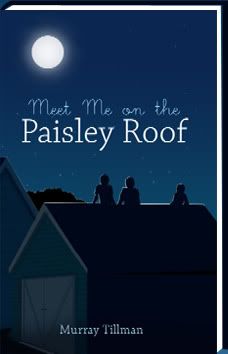
Julia Reviews "Meet Me on the Paisley Roof"

Title/Author: Meet Me on the Paisley Roof by Murray Tillman
Publisher/Year Published: 2009 by Bascom Hill Books
How I got this book: This book was provided free for review by the publisher
Why I read this book: The summary on the back of the book seemed really interesting
Rating: 2.5 stars

I've come to realize about myself that when I read a book, I really like it to be plot driven. That wasn't the case with Meet Me on the Paisley Roof.

This book follows around Trussell Jones over a summer right after he turns 16. He lives with his step mom, whom he lovingly refers to as Shrimp Boat. Some of his main obstacles are trying to get her to let him drive and the girl he's been in love with forever but too afraid to make a move on, Ellen.

This book has really strong characters, even the secondary ones. They are so strong that I can picture them jumping off the page and meeting them in real life. But when I read a book, to get me hooked and wanted to keep pages turning, I need more than that.

Paisley Roof is like opening up a window into the life of a 16 year old boy from the south in the 50s. That's not to say that it is bad, it is what it is. A look into someone's life. It didn't keep me hooked wanting more. Trussell, however, was a wonderful protagonist, his monologue kept things quite interesting.

Along with the great characterization were some wonderful one liners that made me laugh. Or certain situations that I could compare to my own childhood, but overall I guess this book just didn't do it for me personally.

If you like a book about everyday life (with a few teenage shenanigans thrown in there for good measure) with a sense of humor, this is your book. It just wasn't mine.

Wednesday, August 25, 2010

R holds forth on The Sparrow by Mary Doria Russell


The Sparrow by Mary Doria Russell
Villard, 1996
How I got this book: The library!
Why I read this book: I'll go a bit more in depth about it later in this review, but it's pretty much down to this - Priests. In. Space. Awesome.

The monitoring of celestial radio waves pays off in The Sparrow when signals featuring extraterrestrial singing are picked up. Alien intelligent life is out there. While official diplomacy is stalled, the Jesuits organize a private mission of their own, as they have done for hundreds of years with far-flung civilizations back on Earth.

Years later, it is discovered that the sole survivor of the mission (and the main character of the book, for that matter) is Jesuit linguist Emilio Sandoz. He is eventually rescued from whatever Unnamed Nastiness it is that he’d endured, and finally returns to earth amid controversy. The bottom line – What was this Unnamed Nastiness, why the controversy, and what exactly happened out there?

Now, my experience with this book is pretty much a quintessential case of expectations having been set too high.

A number of factors contributed to my initial high expectations: The influential science fiction literary awards this book has won; the high rating on the Goodreads site (currently standing at an average of 4.17 out of 7,833 reviews – and I figured that 7,833 people seemed like a pretty reasonable sample size); the gorgeous cover (it made me want to leave it sitting around in conspicuous areas of my room to act as part of the décor); and most importantly…

I like the idea of books about priests, and I like the idea of books about space. Put the two of them together and as far as I’m concerned, it’s on – as it were – like Donkey Kong.

Add all of that together and I was raring to get at this book. I won’t lie to you, as I checked it out from the library and held it in my hands, I was convinced that I was about to become acquainted with my new favourite novel.

Similarly, though, a number of factors contributed to my bitter disappointment:

The first thing that really, really struck me – certainly for the first half of the book, before the depressing and messed-up stuff really sets in – was that everybody spends the entire time exhibiting how supposedly funny they are and laughing their heads off at each other. Well, I wouldn’t have minded this in the least if the characters actually were funny. As it is, a lot of these droll little conversations probably suffer from the ubiquitous “You Had To Have Been There” syndrome... You know, when something might have been funny if you were privy to it as it is happening, but it turns out to be a lot less funny when retold secondhand, or on a piece of paper. That really frustrated me; possibly a little bit more than it should have, had I not been anticipating really awesome characters demonstrating their mastery of the art of conversation.

The second thing that struck me was the heavy use of character archetypes, because when her characters aren’t spending their time literally ROFLing, they’re busy fitting themselves neatly into character tropes. And I don’t mean science fiction tropes, mind! I mean ethnic stock characters, and priests either deeply repressed or affiliated to the mob. Considering that Russell is a biological anthropologist, it felt a bit like she was cramming in as many of the cultural anthropology stereotypes she’d picked up (in undergraduate Anthropology 101, presumably) as possible. Ooh, it's kind of harsh of me to say that. But it's kind of true.

And another thing, something kind of silly and petty but which never fails to unnerve me a little bit – There is a character somewhere in there who appears to be a slightly fictionalized version of the author. Kudos to Russell for not making herself the main character, but still. Still. These things tend to bother me because it makes me feel like I’m staring straight into the author’s psyche. Which is fine if the author has written an introspective, semi-philosophical piece of work, but generally not so much in other cases.

Anyway, thanks for bearing with my overwhelming negativity up to this point. I didn’t quite dislike the book that much actually; there certainly were aspects of it that I really enjoyed. As I mentioned earlier, I was really drawn to the book in the first place because of its basic idea: A Jesuit mission goes to space and meets aliens, and much religious angst ensues. The bits of the book that dealt with that directly I generally liked – the creation of an imaginary civilization with its own conventions, gender roles and rigid social order.

Another thing I liked was the conceit of alternating the chapters between scenes about the expedition itself and scenes of Sandoz’s recovery after his return. The way she juxtaposed Sandoz’s pre- and post-expedition personalities was, well, just brilliant. Seriously, Russell’s powers of foreshadowing are breath-taking and awesome and added a whole lot to the overall motion of the plot. Well, it added a whole lot to my personal appreciation of The Sparrow, anyway.

Overall, however, while I enjoyed the basic story line and the themes involved, I felt like they could have been presented better. And by “better” I mostly mean “with less scenes featuring the characters falling about laughing about things that aren’t really that funny”. (Sorry for bringing it up so much, but that in particular really irked me!) I’m giving The Sparrow 2.5 stars – I’m not failing it because I still felt pretty involved with the story. In fact I think I might even read the sequel, Children of God, though I’m not so sure whether it’s the sadist or the optimist in me that compels me to do so.

Thursday, August 19, 2010

In Which Snickers Tackles Society Girls


Title/Author: Splendor (Luxe, #4) by Anna Godbersen

Published: October 13 2009 by HarperCollins

How I Got It: I didn't feel the need to waste my money, so I took a trip to the library.

Why I Read It: Sigh. Mostly just to see if Godbersen redeemed herself any from what she did in Envy, and to finish the series so that I could move on to better things.


The Review:

Godbersen has a gift for descriptions that continue to display her abilities as a writer. In this, Splendor matches its three preceding books in its effective descriptions that are not, as in other young adult novels, abused by an overuse of adjectives (can someone say Brisingr?). I could clearly see every scene in my mind's eye as if it was a movie playing just for me.

That said, Splendor's purpose as a novel became painfully clear to me towards the end: a book to tie up loose ends of the plot. While I as a reader regained some measure of the respect I had lost for Diana in Envy, I felt her particular ending to be overly predictable for a character with her personality. As a whole, she plays the overdone part of the strong, independent heroine to a T, and yet it caused me to ho-hum in all its tediousness. The same kind of circumstance can be applied to Carolina's character, as well: a girl who plays the bumbling, lying fool who in the end owns up to her mistakes, and yet still receives a happy ending (though never the one this kind of character expected).

The remaining two females, Elizabeth and Penelope, are different in that there appears to be a sense of forethought and originality on Godbersen's part in their respective personalities, particularly that of Penelope. The selfish, bitchy girls readers love to hate don't often receive their due in their own point-of-view; it was thus a delight for me to be able to follow Penelope in such an intimate way throughout the series. Her character in particular enchanted me until the end. In this respect, Godbersen did not disappoint.

Even so, there was something distinctly missing in Splendor, and with how it met its conclusion. Not quite would I describe it as predictable, but rather that it gave me a nagging sense of "Haven't I seen this somewhere before?" Even after I finished it, knowing this to be the proverbial The End, I couldn't - and still can't - shake the feeling that there HAS to be more to it than what's written in Splendor. Godbersen clearly has talent as a young adult fiction writer, but it may be that she hasn't fully developed and primed her skills yet; I feel she has the potential to have done better with Splendor as a concluding novel.

For what it is, the Luxe series carries its appeal all the way through 'til the end, that appeal being directed towards a young adult audience. For a more mature and experienced reader, however, he or she might find something wanting in Splendor just as I did.

The Rating:

2 ½ stars.


There's really not much to say as to why it warrants 2 ½ stars. I think in this case, my review is self-explanatory.

Monday, August 9, 2010

R holds forth on The Beach by Alex Garland


The Beach by Alex Garland
Penguin, 1996
How I got this book: The library
Why I read this book: It seemed like a good idea at the time.

Some time ago, I made an exception to my usual rule of reading the book before watching the version that moves and talks like it’s really happening – I watched the movie adaptation of The Beach. You know, that particularly fine piece of cinematic splendour (and I say this with heavy, heavy irony) starring the freshly post-Titanic Leo DiCaprio.

And then, some years later, I randomly chanced across the book in the library. So I read it.

In a nutshell, the book is about a secret, closed island community off the coast of Thailand set up by backpackers bored of the overrun tourist-trap beaches on the mainland. It follows a young backpacker (and, to an extent, his acquaintances) as he attempts to reach the community when a mysterious man named after a Disney character gives him a map. This man then proceeds to kill himself in a spectacularly gory way.

Interested? Yeah, I kind of was too. Especially because I’d heard that it differed quite significantly from the movie. What I hadn’t realized at the time was that differing from the movie adaptation does not necessarily mean the original book is any better.

According to Wikipedia (the most accurate source of information known to humanity), the author Alex Garland claims to have accumulated a larger number of movies watched than books read. Yeah. It shows. The Beach comes across as a book that is very much a product of cinematic techniques.

It consists of a collection of short chapters, each one something like one of the scenes in a thriller on the big screen – punchy, engaging, full of anticipation. That’s the best thing about the book, in my opinion: You can’t stop turning the pages because the tension keeps building, even when the characters aren’t doing anything very important in particular. Especially because the characters aren’t doing anything important in particular.

Because if there’s one thing the movies have taught me about idyllic resort islands (cases in point: Jurassic Park, Jaws), it’s that you get your butt out of there quick as you can. Because Bad Things Will Happen and You Don’t Want That. Unless, as a member of a hypothetical movie audience watching the latest blockbusting extravaganza – or as a reader anticipating a climax to an engrossing thriller – you actually want bad things to happen. You want to see sacrifices, you want things to blow up, you want people to expire violently and you really like that sort of thing. In which case:
  1. I’m sure you understand how frustrating it gets when your long-awaited fix leaves you only moderately fulfilled; and
  2. you are a horrible sadist. (But that’s okay. So am I.)

There is a moment within the climax when the shortfalls of Garland’s movie-inspired style make a conspicuous appearance. It’s a particular point when it seems the scriptwriter in him has envisaged a full-blown action sequence, but feels that words are unable to evoke the same excitement that a technicolour punch-‘em-up would. So just when I was bouncing in my seat, keen to know more about what happened next… He left the scene hanging and ended the chapter with a cheerily frustrating ellipsis, like so: “…” That’s right, he made his climax fade to black like the cliffhanger at the end of a movie.

I could have wept in frustration.

So here’s my verdict:
If you’re looking for a reasonably intriguing thriller, this book is for you. But if you’re looking for character development, you might want to look somewhere else.

I give The Beach 2.5 stars, and largely for the chapters when Richard wanders through the jungle pretending to be in Apocalypse Now.
Related Posts with Thumbnails