Showing posts with label biography. Show all posts

Saturday, May 11, 2013

Lori Reviews Pain Parties, Work


Title: Pain, Parties, Work:  Sylvia Plath in New York, Summer 1953
Author:  Elizabeth Winder
Published:  HarperCollins, 2013
Where I Got It:  I received this book from the publishers.

I really like Sylvia Plath.  I love her poetry--it's so honest and real.  Even more than that, I love reading her journals.  In her journals, she sounds like any other young college girl.  Her concerns are/were my concerns--boys, school, clothes, and her appearance.  Yet, you most often hear about Sylvia Plath the depressed artist.  While she was this, she also had bouts of normalcy that masked the pain.

That's what Elizabeth Winder seeks to explore in her study of the month that Plath was a guest editor at Mademoiselle magazine in New York.  Winder walks the reader through the entire process, day-by-day--what Sylvia did and saw each day of the experience.  Plath went into the month extremely excited to become a posh New Yorker.  She spent a good amount of her money on buying just the right clothes.  These clothes would be sophisticated without trying too hard to make her fit in.  She was ready and excited to see the culture of the city.  Yet this summer wound up being the summer Sylvia wrote so truthfully about in The Bell Jar.

Winder uses excerpts from Plath's letters and journal, as well as interviews from her fellow editors.  All of these portray Plath as a young woman who believed that females could be both smart and beautiful.  She was determined to be both.  She was not the pained artist who cared nothing about appearance.  She cared very much about the things that most 20 year old young women care about.  Still, she was quite disappointed and disillusioned by the experience of being a guest editor.

I really enjoyed reading this book.  I think that the author did a fantastic job of pulling together various sources to write a detailed description of Sylvia's month in New York.  I really like the organization of the narrative--Winder covers the first week before covering Plath's life before the guest editor position, the carries through to the aftermath of the month in New York.  She uses a lot of quotations from Sylvia's fellow editors, most of whom could not imagine that Sylvia's life would turn out as it did.  Why?  Because she seemed so much like them.  I like the extra features that Winder includes in the book, such as the text boxes that cover in more detail an aspect of Plath's life, such as talking about Plath's love of paper dolls as evidence of her love of fashion, or the chapter entitled "A Dictionary of Adolescence," which defines some important parts of Sylvia's life.

All in all, I think that this is a great book for anyone who is interested in learning more about Sylvia Plath or for anyone who really enjoys The Bell Jar.

Monday, February 25, 2013

Lori Writes Three Mini-Reviews


Title: House of Earth
Author: Woody Guthrie with an introduction by Douglas Brinkley and Johnny Depp
Published: Harper Collins, 2013
Where I Got It:  The publisher sent it to me for review

I was SO excited when I received the opportunity to review this book and I became even more excited as I read the extensive introduction and became aware of the personal connection with the book.  So...Woody Guthrie is a well-known Oklahoman who wrote many folk songs, including "This Land Is Your Land."  As a young adult, he moved to Pampa, Texas, an area that was heavily hit by the Dust Bowl during the Depression.  My grandparents actually lived about 30 miles from Pampa, so they were geographically very close to the action of the story.  Guthrie wrote the novel in the 1940s, after the events already took place.  The manuscript was lost in Irving Lerner's papers, recently discovered by the archivists at the University of Tulsa.  But as the content of the story shows, the world probably was not ready to read this novel during the Truman era.  However, as economic turmoil and the environment are becoming more and more central to today's discussion, the world was finally ready to read this book.   The story that Guthrie wrote was very touching and is one I will definitely read again in the future.

Guthrie lived in Pampa during the infamously horrible Black Sunday dust storm that occurred in April 1935.  As he survived the storm, Guthrie realized (as the introduction points out) that humans need three things to live--food, water, and shelter.  He chose to write on the third element.  Guthrie began researching the strength of adobe construction and concluded that that type of home would best suit those remaining in the areas afflicted by the Dust Bowl.  But these people rarely owned their own land, and were unable to build permanent structures.  The novel is a call to arms for people to turn on the evil business owners, the bankers who owned the land, and Big Agriculture that destroyed the land.

While Steinbeck wrote about those who gave up and left Oklahoma, Texas, and other afflicted areas, Guthrie wrote about those who were stubborn and brave enough to stay behind and tough it out.  The novel focuses on Tike and Ella May Hamlin, farmers who want a better life for themselves in the face of the Depression and the Dust Bowl.  Tike gets the idea of building an adobe house, but is unable to do so because he does not own his own land.  Central themes to the novel include undying hope in the wake of endless struggling, the abuse of the grasslands by man, and is a socialist call to arms against oppression--all themes still relevant today.  Guthrie explores these topics with a voice that shows his connection with the place and people he's writing about.

A wonderful read for anyone interested in the Great Depression, literature with a social conscience, or fans of Woody Guthrie.


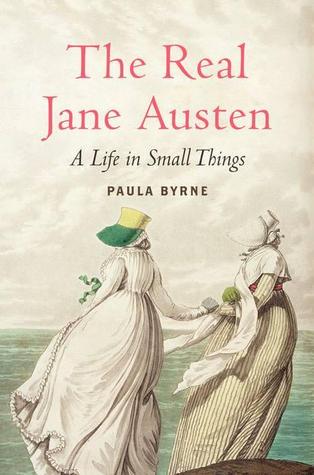
Title: The Real Jane Austen:  A Life in Small Things
Author: Paula Byrne
Published: Harper Collins, 2013
Where I Got It:  The publisher sent it to me for review

This was a very interesting biography for fans of Jane Austen to read.  I'm not going to discuss the actual content of the biography because that could get out of hand.  Instead, I will comment on the approach to the biography.  Byrne takes a unique approach by exploring Austen's life and writing through various themes or moments, which range from her father's religious views to her life in Bath to her struggle to become published.  Each theme is tied to a particular object, such as vellum notebooks and a royalty check.  Byrne ties together Austen's life and her work throughout the biography, including many quotations from Austen's novels.

I am not sure how this biography compares to others on Jane Austen, but I think that this is a fantastic approach to writing a biography and should really set it apart.  It's really the approach that makes the work stand out--Jane's life wasn't exactly action-packed, after all.  

The main issue that I have with the biography is one that many of Austen's biographers have had--there was not a whole lot of documented primary evidence on which to base some of the claims about the author. This, of course, is not indicative of a weakness on Byrne's part.

I think that a good basis of knowledge on Austen is necessary to most fully appreciate the biography, but I think it would be a pleasurable read for anyone who was interested.


Title: Frances and Bernard
Author: Carlene Bauer
Published:  Houghton Mifflin Harcourt 
Where I Got It:  I bought this myself after a Twitter acquaintance recommended it.

I love, love, loved this book!  I read it in two sittings.  I devoured this book like I haven't devoured something in quite a while.

What's it about?  It's about two author--Frances, a novelist, and Bernard, a poet--who met at a writers' colony and started up a correspondence.  It's an epistolary novel, primarily comprised of the letters between Frances and Bernard, but with letters to their friends to flesh out the story.  What begins as a few letters between people who barely know each other quickly becomes a correspondence that can change the lives of the participants.  The story is based on Flannery O'Connor and Robert Lowell.

I loved the voices that Bauer created in this novel.  Frances and Bernard both spoke with such depth and individuality, which is difficult to do when creating characters of the opposite sex and when switching between speakers.  She does not let the voices of the two characters become confused or mixed up--they remain distinct.  Though a story about relationships on the surface, the story is more about human growth and the process of truly finding oneself.

I strongly recommend this book to anyone who loves books about books.  So good!

Monday, February 4, 2013

Lori Reviews Reading Jackie: Her Autobiography in Books


Title: Reading Jackie:  Her Autobiography in Books
Author: William Kuhn
Published: Anchor, 2011 (paperback edition)
Where I Got It:  My wonderful Secret Santa, Kimberly, sent it to me.
 
I am a huge admirer of Jacqueline Kennedy Onassis.  I think that she embodied so much of the grace and charm that I always seek to cultivate in my own life.  She had a varied set of interests that included art, ballet, reading, fashion, decorating, and even pop culture.  All of these are interests of mine as well, which, I think, is why I feel such an affinity towards her.  I first saw press on this book back in 2010 before it was originally published.  I really wanted a copy because I thought the biography was extremely interesting, but just never bought it.  So I was elated when it showed up in my Secret Santa package in December.  I started in on it immediately and finished in a few days, underlining, taking notes, and dog-earing pages throughout.

So...about the book...

Jacqueline Kennedy Onassis was a notoriously private person, who really resented the spotlight's glare on her personal life.  She rarely gave interviews.  She did not write her memoirs.  She even put a ban on her letters and papers being published after her death.  But through the projects she was involved with as an editor at Viking, then Doubleday, she left some clues about herself.  William Kuhn looks at these clues and tells a story about her based on these books and projects and what others have said about Jackie.  During her tenure as an editor, Jackie was involved with upwards of 100 books that speak to her various interests and opinions.

The book opens with a wonderful testament to Jackie's love of reading and books.  From there, Kuhn breaks the biography into several topical chapters--such as a chapter about relationships and a chapter about beauty.  All the while, Kuhn weaves together a narrative that tells the story of the book's publication process and what it meant to Jackie--the chapter on relationships includes a book about Sally Hemings (Thomas Jefferson's mistress) and the chapter about beauty includes a book with pictures of Marilyn Monroe.

I thoroughly enjoyed reading this book.  I learned a lot about Jackie Kennedy while reading it.  I added a long list of books, authors, and topics to investigate to my already long list.  Though maybe some of the connections that the author draws are specious (there's not a whole lot of definitive evidence that she chose to support this book or that book because of a personal connection, in my opinion) there are a lot of coincidences that I think lead the reader to accept these claims as plausible.  It is a book that I will definitely look at again in the future, having quickly become a person favorite.  Another thing that this book did for me was it reignited an old dream of working in publishing, especially as a book editor, so it's given me a career path that I want to work towards.

I would highly recommend this book to people who are interested in Jackie Kennedy or to people who are interested in the concept of how books tell the story of a person.  It's also just a great bookish read.

Thursday, September 6, 2012

Lori's Review of "Every Day by the Sun"


Title: Every Day by the Sun:  A Memoir of the Faulkners of Mississippi
Author: Dean Faulkner Wells
Published: Crown Publishers, 2011
Where I Got It: Amazon.com

I remember seeing a blurb about this book as it was just coming out.  I was pretty interested in it because Faulkner is one of my favorite authors.  However, as per usual, it took me a while to really get around to it.  One of my good friends began reading the memoir and, knowing my love of Faulkner, raved to me.  Once I found out that the 50th anniversary of his death was on July 6 and it was July 5, I decided to make it a goal to read this tome in one day.  It's only 261 pages.  I wound up finishing on the 7th (damn sleep!)...which was the 50th anniversary of when he was buried.  I still count it as a win.

So, the book was written by Faulkner's niece, whom he practically raised.  Dean Faulkner was William's youngest brother.  Dean died in an airplane accident just months before his wife was to give birth to their first child.  Dean's wife gave birth to a daughter, whom she named Dean.  William decided to take responsibility for making sure Dean (niece) lived a good life because he felt responsible for Dean's (brother) death (William was, after all, the one who introduced Dean to airplanes).

From there, Faulkner Wells relates the story of her life and William's impact upon it.  Faulkner practically supported several members of his family in Oxford, Mississippi for much of his writing career.  He never stopped to think about what it was costing him, he just did it.  He provided food, lodging, and other opportunities to many relatives.

Faulkner Wells mainly focuses on illuminating the life of William Faulkner through telling her life story.  Naturally, she spends a couple of chapters telling the family history of the Faulkners (or Falkners, as some branches of the family spelled their name).  She tells heart-warming and heart-wrenching stories about Faulkner's kindness and troubles.  One of the more bittersweet moments, in my opinion, was when Faulkner's four-year-old step-grand-daughter was sent from Shanghai to Tennessee in 1941 (when the Japanese were about to invade) with a note safety-pinned to her coat "Please get me to William Faulkner in Oxford, Mississippi."  I don't know why, but the thought of a four-year-old making a transcontinental flight all alone with such a note just gets to me.

I strongly recommend this book to anyone who is interested in learning more about William Faulkner from the eyes of someone who was very close to him.

Sunday, March 20, 2011

Kelly's Review of "Jane Austen: A Life Revealed"

Title: Jane Austen: A Life Revealed
Author: Catherine Reef
Published: Clarion Books, April 2011
Where I Got It: netgalley.com


Jane Austen may be the author of easily one of the most popular novels of all time, but how much to her readers actually know about her? In my case, not much. Sure, I knew a few things about her, such as that fact that she never married, and....well, that's it.

After finishing Jane Austen, this is in no way true anymore. Catherine Reef's book, while favoring a younger audience, is extremely well written, interesting, and very  informative. The book covers Jane's entire life and almost every aspect of it: her upbringing, schooling, parents, siblings, young love, sickness, and of course, her writing. All of her novels are summarized rather extensively; I initially thought this was an unnecessary part to the story, but the author lets the summarizations connect to Jane's life and the modern movie adaptions are also visited.

Now we all know that every single one of her six novels focus on young women whose economic and social future depends on the fortune they marry into. While this simple plot may sound trivial and petty to us, this was probably the number one worry of females in this era. Historically, women typically did not inherit anything from their parents, except maybe a small sum of money, so they had to look to potential husbands to assure their futures. The richer the man, the better. If women could not find a husband, they were written off as spinsters and became financial burdens to the family members that had to support them for the rest of their lives. Jane Austen experienced these troubles firsthand; though she received several offers of marriage in her youth, she never married and was passed around from her parents and brothers until her death. The fact that she was still able to inject so much humor and wit into her stories puts her miles above what the typical 'spinster' would have done. She obviously loved her family very much, particularly her fellow unmarried sister Cassandra.

Faults? I can only think of one: the pictures included don't really have anything to do with the page they are placed on. You may be reading a section about Jane's writing, and here's a picture of her brother talking about his political career. Sometimes the pictures even served as minor 'spoilers,' alluding to things that hadn't been mentioned yet in the text. Maybe this is only because I was reading an early version of the book, hopefully this is cleared up during publication!

I'd give Jane Austen somewhere between 4 and 4.5 stars. Like I said before, it was an extremely interesting read and I learned a lot...so much so that I was able to use some of this knowledge in a paper I wrote for my Theories of Literature class. Recommended if you like biographies, history, and obviously, the wonderful works of Jane Austen.

Friday, March 18, 2011

Anna reviews 'Stolen Time' by Sunny Jacobs


Name: Stolen Time
Author: Sunny Jacobs
Publisher: Doubleday, 2007
Why I read this book: I was at a talk Sunny gave at college and I instantly went out and bought her book.
Rating: 5 Stars


"I now know from hard-earned experience that each of us, male or female, must at some point take responsibility for ourselves and our lives. That's the way it is. "

This is the biography of Sunny Jacobs, a woman who, at the age of 28 she was sentenced to death for her role in the murders of two policemen in Florida, a crime she never committed. Her death sentence was later commuted to life in prison, and in total, she spent seventeen years in jail, five of which were in solitary confinement. It is an incredibly moving book and makes you think long and hard about whether the death penalty should be allowed.

The book opens with Sonia describing her early years- she got pregnant as a teenager and swiftly married the father of the future child, Kenny. The marraige didn't work- both were too young and immature and they ultimately separated. She moved to Miami in 1973 where she became involved with the mysterious, charismatic and troubled Jesse Tafero. The two moved in together and began trying to make things work as a family. By 1976 they'd been living together for three years and had a child together, their daughter Tina. The night that would shape the rest of their lives happened in 1976 when they were driving to Palm Beach with their friend Rhodes. Two cops pulled them over and a shoot-off happened that left both of the policemen dead. Despite there being absolutely no evidence that either of them took any part in the crime- in fact there was plenty of evidence that neither of them had done it- both were sentenced to death. Her children were taken from her and put into her parents care.

The book then goes on to describe her life in jail. She spent five years in solitary confinement where she passed the time doing yoga and meditating. She continued her relationship with Jesse, where they sent each other letters of love, hope and despair. Ultimately her death sentence was overturned to life in jail. Her parents died in a tragic aeroplane crash in 1982. Naturally she is devestated and her children are put into care. She then describes the horrific murder of her partner Jesse. Jesse was given the electric chair, where it took 13 minutes for the state of Florida to murder him- flames came out of his head while he was still alive. The inhumanity of his death can scarcely be described. Finally, in 1992 after a lengthy court process, Sonia's sentence was overturned and she was released.

"In 1976, when I went in, I was a young mother, a daughter and a wife. When I came out, in 1992, I was an orphan, a widow and a grandmother."Sonia is an incredibly inspirational person and her courage, intelligence, humanity and wit shine through in every page. What she suffered is unimaginable- it is absolutely disgusting that she was sentenced to seventeen years in jail for a crime she never committed, and her husband was brutally murdered for a crime too was innocent of. Although she has plenty to be angry and bitter about, she never loses her sense of humour, she keeps herself busy and she never ever loses her incredible sense of humanity. I was lucky enough to meet this amazing woman last year when she and her partner Peter Pringle gave a talk at my university. I highly, highly recommend this book. It is a womans story of being convicted for a crime despite ones innocence, as well as a broader reflection on the death penalty as a whole.

RIP Jesse Tafero.

Sunday, February 13, 2011

Lori's Review of The Skeptic: A Life of H.L. Mencken

Book Title/Author:  The Skeptic: A Life of H. L. Mencken by Terry Teachout
Publisher/Year Published: HarperCollins Publishers, Inc., 2002.
How I got a hold of this book: I checked this book out from my campus library in Stillwater.
Why I read this book: I chose to read this book for a class.
Rating: 4.5 stars.

H.L. Mencken was one of the best-known critics of the 1920s.  He is probably best known for his involvement in the Scopes Monkey Trial of 1925, however he made his career as a journalist, essayist, editor, and book-writer.  Terry Teachout attempts to rehabilitate Mencken in the eyes of twenty-first century people as Mencken’s “social and political views, long thought irreversibly outdated, have become a resurgent strain in American thought” (xiii).  Teachout writes the story of Mencken’s life through Mencken’s point of view by using many of his own writings as quotations and evidence.  Teachout is critical when warranted, but he states that he attempted to put his criticisms in the proper historical context. 


Mencken was born in 1880 in Baltimore.  At age three, his father moved the family into the house Mencken would live in for the rest of his life, minus the years he was married and one year after his wife passed.  At eight years old, his literary career began when he received a Baltimore No. 10 Self-Inker Printing Press.  Interestingly, his father ruined the lower-case rs, which forced him to use the initials “H.L.” on his work.  He soon read The Adventures of Huckleberry Finn, which shaped his style.  

In his early 20s he began working in the newspaper business.  Mencken’s coverage of the Baltimore fire of 1904 can be said to have marked his transition from “cocky young city editor” (65) to a serious newspaperman.  The author suggests that Mencken might have benefited from college.  True, no class could have taught him what he learned as a newspaperman, but a formal education would have been useful for what he had wanted to do as a critic.  Except for the world wars, Mencken spent the rest of his professional life working for the Baltimore Sunpapers.

Mencken soon entered the magazine world with a friend George Jean Nathan.  They first edited Smart Set, but eventually began working on the American Mercury.  This magazine has become a symbol of the 1920s, though probably far more people had heard of it that had seen, much less read, a copy.  The magazine had literary features, but also editorials and articles on all aspects of American life.  Everyone seemed pleased with the Mercury except Bible Belt editorial writers, liberal intellectuals, and Nathan.  Many pieces of the Mercury were so heavily edited and rewritten that they all sounded like Mencken wrote them, which was fine initially because he was the main draw, but it did not lend itself to longevity.  By 1929, the most astute critics realized that Mencken had run his course, was on the verge of over-playing his hand, and had missed the points of the 1920s.

Throughout the 1930s, Mencken churned out editorials and numerous books.  The constant theme in his articles was the ineptitude of Franklin Roosevelt and his New Deal.  The big difference from his earlier work was that hardly anyone was laughing anymore.  Teachout asserts that Americans probably were not so reluctant to laugh, as they were tired of laughing at what Mencken laughed at (258).  During the war Mencken went into exile because of his views toward Hitler.  All his life he was very proud of his German heritage.  And, while he would never have approved of what Hitler was really doing, Mencken underestimated Hitler, calling him a boob, rather than seeing him as evil.  Because Mencken refused to attack Hitler in his writings, he began getting the wrong kind of attention.

In 1948, Mencken had a massive stroke.  It affected the part of his brain that allowed him to read and write.  He lived a life of limited mobility for the next eight years and still managed to publish some books that he dictated to his stenographer.  Mencken, either actively, passively, directly, or indirectly helped the careers of Theodore Dreiser, F. Scott Fitzgerald, Raymond Chandler, Dashiell Hammett, Sinclair Lewis, and Evelyn Waugh, among others.  He published many books on topics that interested him.  He began with the first work on George Bernard Shaw and wrote In Defense of Women, Damn! A Book of Calumny, The American Language, Treatise on the Gods, A Mencken Chrestomathy, and a number of posthumous collections.

I really liked this book.  I thought it was a very interesting approach to a biography.  However, I got tired of Mencken as a historical figure because, it seemed, he latched onto a subject and satirized it over and over until it had passed from relevance and amusement into extreme weariness.  Mark Twain, whom Mencken idolized, also did this.  Still, I think Mencken is a worthwhile character to read about.  Teachout's style is very clear and straightforward.  The author does a good job of staying with his chosen focus--the evolution of Mencken's writing, while integrating the personal story in a seamless way.

Saturday, February 5, 2011

Kelly's Review of "A Million Little Pieces" by James Frey

Author: James Frey
Published: Nan A. Talese, 2003
Where I Got It: Goodwill
Why I Read It: I decided to branch out of HF for once!


Oh Oprah, you and your book club choices! I actually scraped the O sticker off my copy of the book before I read it in public...but that's a whole other rant.

Anyways, this was a pretty interesting story about James Frey's six week stay in rehab when he was 23 years old. We learned about his life before he was hospitalized, and then the people he meets along the way. I actually liked hearing about his new friend's lives and struggles more than James'. We are also graced with some really disgusting descriptions of vomit.

I was very disappointed in the way that James actually kicked his habit...he basically passed off his meetings and exercises and didn't do much of anything. I think this is misleading, leading other to think that just staying in a rehab center for six weeks, separated from your drug of choice, will instantly cure you. I don't know, maybe this is the point? In my opinion, it was rather weak.

However, the thing that bothered me most about A Million Little Pieces is rather ADD on my part: there are absolutely no quotation marks in the writing. None. It's a bit of a struggle to read and follow along with who is saying what and when. Also, commas are very sparse, rarely used when they are obviously needed.

Towards the end of the book, James is 'confessing' his sins (even though he doesn't believe in a god) and writes down all the sins he can remember committing, starting from when he was just a child. He truly did some horrible, horrible things in his pre-rehab days; this just reinforced the fact that I honestly never felt sorry for him once...until I go to the very last page. It absolutely broke my heart.

I also kept picturing the narrator as James Franco's character in Pineapple Express....the dirty pajama pants and messy hair.

I missed the whole controversial arguments involving the book, but I honestly don't care, it was still just a 'meh' for me. 3 stars.

Sunday, October 17, 2010

Kelly's Review of "Cleopatra: A Life" by Stacy Schiff

Title: Cleopatra: A Life
Author: Stacy Schiff
Published: Little, Brown and Company, November, 2010
Where I Got It: Tahleen sent it to me, courtesy of Hachette!
Why I Read It: I love pretty covers.

The number one thing that I learned from Cleopatra: A Life was this: I had deceived myself in thinking I knew anything about her before reading this book. Stacy Schiff digs deep into the life of one of the most well-known yet misunderstood women in history. Most of us know her as the Egyptian queen who had affairs/children with both Caesar and Mark Antony, the two most powerful men of their age. She herself was much, much more than that.

Cleopatra was a fabulously rich woman. In contemporary terms, her net worth would be around $95.8 billion dollars. She was worth more than three Queen Elizabeth IIs. Amazingly, she also lived in a culture were women were greatly empowered. A woman in first century B.C. could choose her own husband, own property, grant their own divorces, operate businesses, and serve as priests. As much as one third of Egypt was controlled by female hands.

There are many other things that stick out to me about Cleopatra's life. The biggest was her incestuous family ties. Her grandparents were uncle and niece, her parents were brother and sister, and Cleopatra herself was married to both of her brothers. I question how there were no physical or mental deformations! Another interesting point pertains to her beauty. Third century A.D. records call her "strikingly exquisite" in appearance, while those of the Middle Ages say she was "famous for nothing but her beauty." Shakespeare raves about her looks. However, her contemporaries, those who actually knew and saw her, say nothing about her beauty. In fact, her appearance was called "not remarkable." Quite different from what most of us have heard about her!

Stacy Schiff wrote an extremely entertaining book full of fun, interesting facts. I loved her sarcastic voice and the humor she injected into the characters. I will say that it seems to drag on forever at the end. The story began to focus too much on Mark Antony and the military, which quickly lost my interest. I skimmed the last 100 pages. That being said, I'd rate it 3.5 stars; the plethora of amazing facts was overshadowed by the fact that I felt I had to force myself to even finish it.

This book hasn't even been published, yet it is already the basis for a movie to be released in 2013, starring Angelina Jolie. You can read more about it here.

Sunday, September 19, 2010

Tahleen reviews: "Charles and Emma: The Darwins' Leap of Faith" by Deborah Heiligman


Author: Deborah Heiligman
Publisher: Henry Holt & Co., 2008
Where and why: I saw this on display at my local library. I heard it had won a few awards and was curious about it, so I checked it out.

Rating: ★★★½

Deborah Heiligman takes on the challenge of writing a biography of one of the most famous scientists in history and his beloved wife, for young readers. But this isn't just a cut and dry book about science and religion—it's a love story that succeeded against all odds.

This was a great overview of the Darwins' life together. Emma was a devoted Christian, and Charles was a devoted scientist with serious doubts about God; yet they managed to make it work, so great was their love for each other. We start off with Darwin's famous pros and cons list of marriage, moving on to his first failed engagement, and finally into his marriage with Emma. Heiligman shows her readers why Emma was such a devoted Christian, why Charles couldn't believe like she did, and how they somehow met in the middle. We share their joy in the births of the children and their sorrow during death, up to the end of their own lives.

It is aimed at the young-adult reading level, and the writing was spot-on for that demographic, but I'm just wondering how many sixth-graders are going to want to read an entire 232-page book about Charles and Emma Darwin. It took me a while to get through it, and I'm in my 20s.

I did really enjoy how Heiligman delved into how the Darwins dealt with the fact that their spiritual beliefs differed so greatly, and yet they were so in love for the duration of their lives. It's a beautiful story, really. At the time I read it I could identify with some aspects of it too, and it really put my own situation into perspective.

Heiligman also does a wonderful job at characterizing these historical figures. We see Darwin's brilliance and his humor, his virtues as well as his faults; we see Emma's passion and devotion, her love and loyalty for her family. It's clear she wants her readers to get to know her subjects, instead of just learning about them.

All in all, this was a great biography for younger readers—the only problem was that it dragged a bit in some places for me, and so I immediately thought of how middle schoolers would take to it. Provided they can get through it, they'll certainly learn a lot about the Darwins and what they put themselves up against. I would even recommend this to adults who are interested in learning more about the famous couple.
Related Posts with Thumbnails