Sunday, October 31, 2010

Lori's Livres--One Hundred Years of Solitude by Gabriel Garcia Marquez

Book Title/Author:  One Hundred Years of Solitude by Gabriel Garcia Marquez
Publisher/Year Published: My edition was Harper Perennial Modern Classics, 2006, but the book was initially published in 1967.
How I got a hold of this book: I bought this from Borders one summer day.
Why I read this book: The overwhelming desire to yank this book from my shelves this summer came over me and I obliged.
Rating: 4 stars.  It was a pretty good book.  I'm glad I read it.  But there wasn't a magical connection between the two of us.

This was the second book by Marquez that I've read; the first was Love in the Time of Cholera.  One Hundred Years of Solitude is known for its magical realism, which is a style that Marquez perfected and used throughout his body of work.  One Hundred Years of Solitude follows the Buenadia family through seven generations of fortune and misfortune, invading outside influences and internal strife.

My thoughts on this book are kind of complicated and intermingled.  I liked the concept of the story--following a family's rise and fall.  This book reminded me a lot of East of Eden, which is one of my favorite books, in that respect.  There is the honorable patriarch who descends into madness, at least according to everyone else, and his rotten children who mess up everything by trying to be innovative and slightly underhanded.  There were numerous ups and downs in this book, as there are in life.  Progress doesn't always lead to better things, especially in the long run.

While we're on the topic of characters...I felt that some of the characters in this book were mere caricatures who were really overdone.  All in all, I didn't like the characters of this book.  I couldn't relate to them.  And many were flat out despicable.  It was probably intentional that the characters were like this, but I have to feel invested in the characters when I read.  Also, the characters all had the same names from generation to generation, which made things very confusing.  Luckily, there was a family tree that I referred to many times.

What ultimately redeems this book for me is its style.  I really like Marquez's prose.  They are simple, direct, but also lyrical.  For whatever reason, good prose and writing style can make up for a lot in my reading experience, even less than desirable characters.  It's almost as though the prose are a separate entity, detached from character and plot.  It's his prose that have me give this book a 4.

A Broke and Bookish Secret Santa


Hello everyone! We are planning a Secret Santa exchange--broke and bookish style. We've done a Secret Santa as part of our College Students group on Goodreads so we thought it might be fun to extend it to our blog as well. We want this to be a low key and fun Secret Santa that doesn't put too much of a damper on your wallet.

Please only sign up if you are truly interested and are committed to sending off a package.

Some guidelines:

* Books can be new or used. Use your discretion as far as used books go. They should be in good condition. Please pick at least one other goody to put in the package.
*We would love to open this up internationally and will make an effort to pair up people from the same countries to keep costs down. However, if anyone would like to do an international exchange, you can fill out that box on the form.
*Sign-ups will be open until November 17th. You will be paired up and will receive your partner's info within that week.
* Myself and maybe another (very trusted!) member of The Broke and the Bookish will be the only ones with access to your info.
*Packages need to be sent out during the week of December 6th-10th. The earlier the better as the mail is always slow during the holiday season.
* If you can do delivery confirmation on your package, that would be greatly appreciated to make sure that the package was sent.
* Please email me at brokeandbookish (at) gmail (dot) com when you receive your package so I can keep track of which packages have been accounted for.
* Feel free to grab the button to put on your sidebar. 

Think you are interested?

Fill out this form!

EDIT:

I forgot an extremely important element to this Secret Santa. Everyone who participates is in the running to be randomly selected to get one of the books of their list. This drawing will take place sometime after Christmas. I'm not sure the exact date yet as the holidays are always busy and I never know where I'll be!

Saturday, October 30, 2010

R holds forth on The Prime of Miss Jean Brodie by Muriel Spark


Penguin, 2000
How I got this book: The library
Why I read this book: It's a school story and I like school stories.

The Prime of Miss Jean Brodie is about the titular teacher, an unwelcome iconoclast in a stuffy Edinburgh primary school, more interested in giving her young students a humanities-based general education than in sticking to the prescribed syllabus. From among her students a few favourites emerge, soon to be known as the Brodie Set, whom she takes into her confidence and attempts to mould into "the creme de la creme".

But in this case, her influence over her students does not culminate in the happy resolution that many school stories tend to end with. Because this is Dead Poets Society's inspirational message gone wrong.

The various synopses I'd read before deciding to pick the book up had led me to believe that it was another uplifting school story, dealing largely with the students' evolution under the tutelage of their eccentric teacher. As such, in spite of the short length of this novella, I had been expecting swaths of character development and lots of delightful little classroom scenes about how wonderful it is to be taught by an unconventional lady "in her prime".

However, the characterizations only scratch the surface. Each member of the Set is tagged with a label early on - "known for sex" or "for being a nobody whom everybody could blame", and so on - and throughout the rest of the story they conform to these labels steadfastly.

Understandably, that may well be perceived as a narrative flaw, but I reckon that it doesn't necessarily have to be. In fact, I'd argue that most of the characters are pretty much just peripheral - even several members of the Brodie Set - despite the synopsis on the back cover that suggests that the novella is primarily about teacher-student interaction. As the title suggests, and as I stated in the opening sentence of this review, this book is about Miss Jean Brodie - the prime years of her life, and her subsequent decline. It is, to a small extent, about her students as characters in their own rights; and to an extent it is also about Brodie's relationship with one student in particular, whose perspective is returned to the most in the narrative.

Above all, at the heart of the story, I think, is Miss Brodie herself, the tragedy of a blinkered, artistic temperament, and the loneliness of not finding a place of one's own in society even in middle and old age.

This story will be staying with me for a little while. I give it 4 stars.

Friday, October 29, 2010

Jess' Review: The Crisis of Islam (Bernard Lewis)

Image from Amazon

Author: Bernard Lewis (Web site)
Publisher: Random House, 2004
Notes: I checked this book out of the library.


A brief summary: "After the terrorist attacks of September 11, many Americans yearned to understand why Muslim extremists felt such passionate animosity toward the Western world, particularly the United States." (Quote from Goodreads.) This book aims to explore the historical bases for this animosity.

My thoughts:I read Bernard Lewis' The Crisis of Islam as part of a seasonal challenge at the College Students group on Goodreads. I have never embraced Lewis' approach to the Middle East—or more specifically, the Arab World—or Islam, thinking that he often takes a reductionist point-of-view that serves to reify Westerners' beliefs about Arabs and Muslims. I would not recommend this book to anyone who does not already know some basics about Islam or the Middle East. Lewis confirms American suspicions of the region and the religion instead of breaking down barriers to understanding.

Lewis starts out by stating that former President Bush was involved in a fight against terror, but not Arabs or Muslims, yet Osama bin Laden was in a fight against the United States. While this is true to an extent, it ignores the historical and political realities. Bin Laden utilized religious rhetoric to create an "us" versus "them" dynamic, but ultimately he is concerned with geopolitical issues like invasion and occupation, which one could read in his writings, Messages to the World.

Moreover, Lewis spends a good portion of his book relating Christianity and Islam before stating that there are, despite these similarities, profound differences. I start first by saying that Christianity is a faith-based religion (not practice-oriented, with the exception of Orthodoxy and Catholicism, to some extent). Islam is both orthodox and orthoprax, meaning that there's emphasis on both "right faith" and "right practice." Judaism tends more toward orthopraxy. Given the elements that Lewis focuses on—religious authorities' perspectives on justice and morality, apostasy, etc.—it would probably have made more sense to compare and contrast Judaism and Islam.

Lewis also spends an enormous amount of time talking about jihad. Jihad is a word that loosely means "struggle," and for religious Arabic speakers, it usually refers to a personal struggle (sinfulness, indulgence—the same sorts of things that plague "us normal Christians"). However, Lewis discounts this, saying that progressive Muslims like to say that jihad means a personal struggle, but that throughout Muslim history it refers to holy war. But what, you might ask, does he think about the Crusades? He argues that while jihad is embedded in early Muslim history, the Crusades are a departure from good Christian society and behavior. I am flummoxed by this conclusion. Additionally, Lewis discusses apostasy; he cites that the penalty for apostasy in Islam is death, which is harsher than any other religion. I cannot be sure that this is in the Qur'an or not, but my guess is that some Muslim leader or scholar once said this. However, these pronouncements need more evidence to be compelling, at least for me. I think that the uneducated reader or one looking to reaffirm his beliefs in the evil of Islam will take this at face value, which is quite unfortunate.

To be fair, Lewis is well-read in the area of Middle East and world history, and employs this knowledge in his argument. He even recognizes the importance of jizyah (a tax installed for recognized non-Muslim communities in Muhammad's time and in the early years of Islam) for the dhimmi (recognized non-Muslim communities).

Rating: 1 star

Thursday, October 28, 2010

Kelly's Review of "Sense & Sensibility" by Jane Austen

Title: Sense & Sensibility
Author: Jane Austen
Published:  Oxford University Press, 2004 (originally 1811)
Where I Got It: The library
Why I Read It: I was reading all of Jane Austen's novels in order of publication

*This review contains marked spoilers*

I think that most of us can agree that, yes, Pride & Prejudice is a great novel. The characters and overall plot are memorable and inspiring, yet I feel it greatly overshadows some of Jane Austen's other wonderful books, such as this one.

In Sense & Sensibility, the two main characters are sisters, Elinor and Marianne Dashwood. They live a comfortable, well to do life with their parents. When their father dies, all his property reverts to his son from a previous marriage. The Dashwood women are essentially left homeless and must start a new life living in much more modest means. The story follows the girls in their new home as they meet new friends, encounter dramatic situations, and of course, meet men and fall in love.

The sisters both deal with love and heartbreak simultaneously, although in completely different ways. Elinor is more mature and gentle with her feelings, while Marianne weeps loudly and stomps around for weeks. As a person who identified with Elinor emotionally, I become slightly irritated with Marianne's dramatic ways, but her general youthfulness and fun spirit definitely made up for it in the end (she's barely 17 after all).

*SPOILERS*
The way their respective 'love stories' turned out in the end took me greatly by surprise. Did anyone else feel completely shocked that Marianne married Col. Brandon? I later realized that, duh, this is what the whole story is wrapped around and leads up to, but still. I'd been picturing him as a very old man in my head the whole time, that's probably why it was so odd. Yet the more I think about it, the more I like this couple. Brandon made Marianne finally grow up.
*END SPOILERS*

I felt that this book was much lighter than any of Jane Austen's other works. Many of her common themes show up (death, sickness, betrayal), but not in as much abundance and it is taken in a much less serious mood. The characters have their flaws, but they ultimately end up being endearing. 4 stars for a fun and lighthearted classic read.

If you enjoy movie adaptations of books, I highly recommend the 1995 movie Sense & Sensibility  starring Emma Thompson and Kate Winslet. It is extremely well done and true to the book, as well as being delightfully entertaining. Also, if you are a fan of the Harry Potter movies, you will find a slew of those actors in this movie as well. Professor Snape, Madame Pomfrey, Professor Slughorn, Professor Trelawney and Umbridge all show up! Hugh Laurie also has a small but memorable role. :)

Wednesday, October 27, 2010

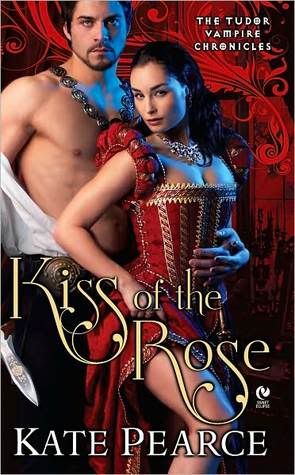
Julia Reviews "Kiss of the Rose" by Kate Pearce


Title/Author: Kiss of the Rose by Kate Pearce
Publisher/Year Published: 2010 by Signet
How I got this book: Library
Why I read this book: The cover drew me in as did the words "Tudor" and "vampire"
Rating: 3 stars

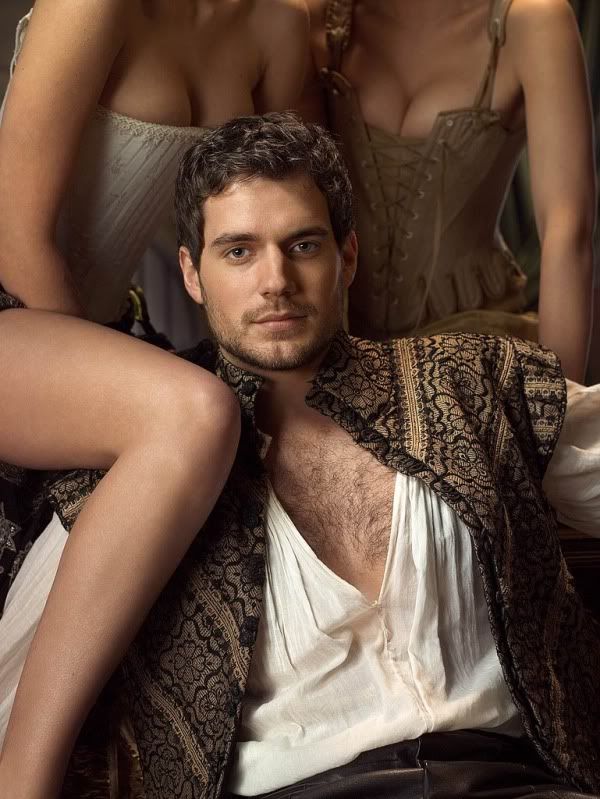
I have a problem. My name is Julia and I judge books by their covers. In this case, the remarkable similarity to the promotional materials from the Showtime show The Tudors in combination with the sexy look of the cover man (who looks eerily similar to Henry Cavill... see below) drew me.

"What's this? Sexy mostly shirtless man? Pretty dresses? Exposed leg? I am intrigued" Then I read the words "Tudor Vampire Chronicles" and I was sold. Two of my favorite things formed one potentially awesome entity, but sadly these two favorites come together just as well as two of my other favorite things: chocolate and onions. )

Let's look a bit at the story: we have two sides. The Druids are the Vampire slayers sworn to protect the Tudor crown. They send their girl slayer to court. The Vampires have their own cult protecting them as well. This cult, sworn Druid killers since Roman times, sends their sexiest son. Neither gets along, but now is forced to cooperate when a rogue vampire is threatening all of their livelihoods, as well as the king's.

There is good. The characters are well rounded and believable, the plot moves along at a good pace, and it's generally an interesting story. There is bad, too. None of the aforementioned good things every really clicked for that perfect harmony of awesome. Something just kept me from being engrossed.

There were quite a few times I felt the story could do with more vampires, less love triangle. Also, occasionally characters would act counter intuitive to their overall plan. Also, there were just some things that I just couldn't understand time period wise. Like no one really questioned a young woman wandering about at will, not really doing her duties are the queen's lady. Also, I am pretty sure at one point I said to my book "Aren't you suppose to be Slayers! Slay something!"

I think my problem with this was I know too much about the Tudors and vampire lore to disassociate what I already know. Some things just deviated too far into paranormal, and not close enough to Tudor England. It was not a bad read; I did finish it. It just didn't click with me.

There is a sequel and presumably a series (if the term Chronicles implies series). Will I be reading on? Probably not.

So I give it 3 stars, for a good go and for a highly effective marketing team.

Tuesday, October 26, 2010

Tahleen's Top Ten Books for Halloween

Top Ten Tuesday is an original feature/weekly meme created here at The Broke and the Bookish. This meme was created because we are particularly fond of lists here at The Broke and the Bookish. We'd love to share our lists with other bookish folks and would LOVE to see your top ten lists!

Each week we will post a new Top Ten list complete with one of our bloggers answers. Everyone is welcome to join. All we ask is that you link back to The Broke and the Bookish on your own Top Ten Tuesday post AND sign Mister Linky at the bottom to share with us and all those who are participating. If you don't have a blog, just post your answers as a comment. Don't worry if you can't come up with ten every time...just post what you can!


Hi everyone! This week I wanted to do a Top Ten Tuesday in honor of Halloween, so I've picked out my top ten 10 spooky/creepy/scary books for the season. And, okay, some of them might not have actually scared me, but they are appropriate for Halloween.


1. Dracula by Bram Stoker: Gotta pay homage to the guy who made vampires scary and brought them into pop culture. Plus this book is pretty creepy, what with the dead coming back for the blood of the innocent and all.


2. Frankenstein by Mary Shelley: This is not so much scary as, again, a work that has influenced countless others. I would argue that this is the first real science fiction novel, though if you can think of an earlier one let me know!


3. In the Forest of Hands and Teeth by Carrie Ryan: I usually hate zombie anything, but this was so character-driven and the writing was so wonderful that I completely overlooked that. It was only afterward that I started to get the heebie jeebies, but it was totally worth it. Definitely a good Halloween-time book if you can handle the scary factor.


4. Life As We Knew It by Susan Beth Pfeffer: This is a different kind of scary: the end-of-the-world scary. No post-apocalyptic book has made me so grateful for the life I lead and that our moon is staying put. After putting this one down I had to remind myself that I didn't need to squirrel away incredible amounts of canned goods.


5. Sunshine by Robin McKinley: Not necessarily scary, but one of the best vampire books I've ever read, ever. And I've read a lot. But this is certainly for the more mature reader, and not little kids (language and sexual content and whatnot). But seriously, READ IT.


6. The Road by Cormac McCarthy: Again, the post-apocalyptic scariness. Add to this the cannibals roaming the land in search of any flesh, but mostly human. Terrifying to think about a world where there is no order except the strong turning against the weak... and eating them.


7. Coraline by Neil Gaiman: The button eyes! THE BUTTON EYES. It's creepy, but also, what an awesome character. Coraline rocks.


8. The Zombie Survival Guide and World War Z by Max Brooks: I admit, I didn't read these because of my fear of anything zombie. I did own them, but I got too scared to read them and just ended up donating them to my local library's book sale.


9. The Bailey School Kids series by Debbie Dadey and Marcia T. Jones: So yes, not scary. But so clever and fun! I love this series, and always will. Especially Werewolves Don't Go to Summer Camp, probably because I believe it was the first one I read.


10. Scary Stories to Tell in the Dark and sequels by Alvin Schwartz: We listened to some of these one tape in the third grade, and the one about the head falling down the chimney scared me for YEARS. No lie. But it was more the pictures in these that really make them scary. The old ones that I grew up with are TERRIFYING. Just look at this:


Yeah. Good luck getting to sleep tonight.


What are your top ten scary books? Or just favorite ones to read near Halloween?


Next week the topic is: Top Ten Books That Made You Cry


Related Posts with Thumbnails