Showing posts with label plays. Show all posts

Friday, November 16, 2012

Jen Reviews Death of a Salesman

 
Title: Death of a Salesman
Author: Arthur Miller
Originally Published: 1940
How I Got It: Purchased at a library book sale


GoodReads Summary:
Willy Loman, the protagonist of Death of a Salesman, has spent his life following the American way, living out his belief in salesmanship as a way to reinvent himself. But somehow the riches and respect he covets have eluded him. At age sixty-three, he searches for the moment his life took a wrong turn, the moment of betrayal that undermined his marriage and destroyed his relationship with Biff, the son in whom he invested his faith. Willy lives in a fragile world of elaborate excuses and daydreams, conflating past and present in a desperate attempt to make sense of himself and of a world that once promised so much.


Review:

I'm not much of a play person.  I don't mind watching them but sitting down and reading a play was never my thing.  Over the summer I saw Death of a Salesman at a library book sale for fairly cheap and thought I was overdue for a reread (or I guess technically a first read).  See, when I was in high school I wasn't much of a reader would read SparkNotes instead of reading most of our required reading.  Now I feel like I missed out on a bunch of classics!  But it was nice to be able to just read the play and not worry about having to analyze it or look for symbolism.

I must say I barely remembered anything about the play.  Really the only thing I remembered was that the father was a traveling salesman who wasn't doing so well.  But overall I did enjoy the story!  I almost read the entire thing in one sitting and if my stomach wasn't growling I definitely would have!

One thing I found slightly confusing was when Willy would slip back into his daydreams or memories from the past.  Sometimes he would be having a conversation with a person in front of him and a different conversation with a person in his head.  Reading that was confusing but I'm sure if I saw the play being performed or even having different people read for each character (just like we use to do in English class!) it would have been fine.

My heart truely went out to Willy.  He spent years working for the same company as a salesman but is getting older and wants to cut back on traveling.  All he wants to do is provide for his family but it seems like he can never catch a break or he's just fighting with his sons. 

I recommend you read this play and not just skim through the SparkNotes!  You really do get so much more of of it!

For someone who is interested in reading more plays do you have a favorite one?  Or a least favorite you'd advise to stay away from?

Thursday, February 3, 2011

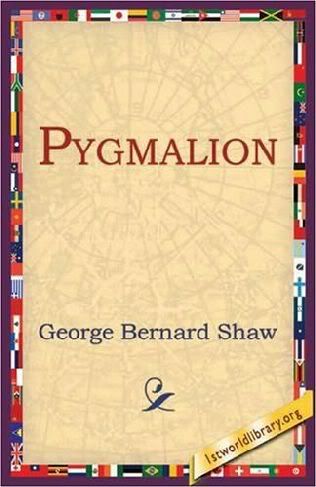
Julia Reviews "Pygmalion" and discusses Books vs Movies


Title/Author: Pygmalion by George Bernard Shaw
Publisher/Year Published: first published 1914
How I got this book: my copy is a B&N Classic eBook that I downloaded free during the summer
Why I read this book: I've always loved Shaw's quotes. I wanted more.
Rating: 4.5 stars

When I was thinking about the review for this week, I thought about all of the award shows going on now. This inevitably brought me to book adaptations and the changes that often occur between the source material and the final product. I thought about the review I did of Pygmalion last summer on my own blog:

Just a warning before we begin. I go a little into detail about the relationship between Eliza and Henry which includes commentary about what happens after. If you have not seen the play and want to be surprised, be warned.

When I was in high school, I tried out for Pygmalion. I didn't get any part and in my anguish did not go see the show. I had heard that My Fair Lady was based on this play, but I've never seen that. I've read the myth about Pygmalion, but honestly didn't make the connection until I was reading the footnotes. So suffice it to say all I knew about Pygmalion's Eliza and Henry I learned from Family Guy.

So with practically a clean slate I dove in and I must say I rather enjoyed myself. I've always liked the quotes I've seen by Shaw floating around the internet, but never made the connection to the playwright.

It was interesting, surprisingly funny and quite entertaining. I could see in my head some of the cues onstage and how well they would work. I enjoyed Eliza and Henry's interactions the most, and was honestly quite confused by the ending. I clicked next page and there was no more play, but a nice essay by Shaw about what happened after. Toward the end there is quite a conversation between Higgins and Eliza which to me it dripped with sexual tension, but that was just my romance novel reader brain apparently. Because that is not how it ended. It was really interesting reading Shaw talking about why he chose to end the play the way he did going against what the mainstream public would want. Apparently, he added this afterword because everyone kept asking, but why can't they be together?

There have been times, wikipedia told me, that certain directors have changed the ending to suit the happiness of the audience, but I understand where Shaw is coming from. The play he wrote is a jab and society. Its a comedic satire, not a love story. There is no need for a happily ever after, because this is supposed to be real life. It's interesting also because the myth of Pygmalion has the sculptor living happily ever after with his creation, so he even deviated from the source material.

I don't know how I feel about changing the ending to suit the coffers. Part of me says "If you don't like it, write your own play!" but the other part of me says "Gotta do what's best for business." I am not really curious to see how My Fair Lady ends but I would tend to be more lenient about this seeing as it is an adaptation of the play.

So in conclusion, this really is a great play. I really enjoyed it and would love to see it onstage at some point.
Well, I saw the movie adaptation version, My Fair Lady since then and (outside of the fact that I thought it overly long.. but that's a different story) it bothered me that it changed. It gives the feel of the movie something different from what Shaw intended.

There are so many times when this has happened to me, where Hollywood changes some key piece in a treasured piece of literature (I still refuse to see The Golden Compass) and just changes it. Completely misses the point. Sometimes I guess it works out okay. After about three viewings of Return of the King, I felt comfortable with the changes. And yeah there are definitely times where movies make an obscure book known to mass culture. But overall it just makes me sad when things get changed, especially when it changes the intended meaning.

So I open it up to the floor. How do you all feel about books being made into movies and the changes that inevitably happen?

Thursday, January 20, 2011

Where Bookishness and Thespianism Collide

It all started off as a discussion of what movies would make the best musicals, the topic then moved to movies would make the worst musicals (Star Wars the Musical anyone?). Then of course, being bookishly inclined I started thinking of what books would make good musicals.

I'll warn you right now, I am an English Major and one of my minors is Theatre, so this entire post with be a theatre/book geek fest. Just so you know and are fairly warned ahead of time.

This was originally going to be a Top Ten Tuesday, until I realized (i. e. I was told) that not many people are as geeky as I am in this respect and it would make a difficult list for others to duplicate. (We will, however, be doing a Top Ten Tuesday about books that SHOULD be movies).

We already know there are several books that have been made into successful musicals, Wicked for example. It made an excellent musical. (In my opinion anyway, but it happens to be my favorite musical. When I finally got to see it performed, I started crying when I heard the opening song.... I digress.) The Secret Garden has also been made into a musical, I'd venture to say it's better than both the book and the movie.

Here are a few of the books I thought might make a good musical.

The Outsiders- If this was done properly, it could be very powerful. I'm thinking a rock type of music. Something similar to West Side Story, without the cheesy dance-fight. (Which I'll admit, is kinda cool. But I'm a geek like that.)

Tuck Everlasting- Loved this book. The movie was good too, though. The style and storyline of the book already feel like a musical, minus the music. I really think that a great musical score could emphasize the magic and the story and give more depth to the characters if they were given the right songs to perform.

Pride and Prejudice
- This has already been turned into a musical-- twice. Both of them flopped. I still hope to see this as a successful musical I think it could be great!

Secret Life of Bees- I think this would make a powerful musical. Maybe something similar to The Color Purple?

Anne of Green Gables
- (This has already been done as well, but badly.) Love the books and I love the first two parts of the TV version. Can't you just picture this as a musical? Imagine Rachel Lynde with some kind of song that shows off her rather prickly personality and her way of knowing everything that happens? Pick a little, talk a little, pick a little, talk a little, cheep cheep cheep, talk a lot, pick a little more. Oops. Wrong musical.

Hitchhikers Guide to the Galaxy- This is such a wacky novel, why not turn it into a musical? I think it would be hilarious. Something similar to Monty Python's Spamalot.


To Kill a Mocking Bird - I could see this being incredibly powerful if it was well done. Something similar to Les Miserable.

Memoirs of a Geisha I could see this being not only very powerful, but beautiful. The imagery in the book was gorgeous, can you imagine how wonderful it would look on stage? Pair that with an great score and you've got yourself a pretty amazing musical.

So those are just a few books I thought would make good musicals, I also thought of a few that would make terrible musicals.

Such as...

The Hunger Games- It would be terrible! I mean, really, could you see any of these characters suddenly bursting into song?

The Girl With The Dragon Tattoo
- Do I really have to say anything? It would be... well bad. Just bad.

The Abhorson Trilogy- Those who have read it will understand.

Anything by John Grisham.

Ender's Game- Uh, it's not going to happen. Not only would the weightlessness for most of the novel be difficult to replicate on stage, I just can't imagine the characters singing. Ever.

Any book by Steinbeck.

So those are just a few of my ideas. It gives you a glimpse into how my mind works (which might have been a frightening experience for some). When I read a novel I think would work as a musical I immediately switch into actor/director mode. I can see how I'd lay out the stage, the type of music I'd want, how I'd block (block meaning the movements the actors make) the scenes, the costumes, everything.

So what about you? Any books you think would be great musicals? Or have a few in mind that would be terrible?

Tell me what you think!

Thursday, December 9, 2010

Kelly's Review of "Ophelia" by Lisa Klein

Title: Ophelia
Author: Lisa Klein
Published: Bloomsbury USA Children's Books, 2006
Where I Got It: My favorite used bookstore

I may be going out on a limb here, but I think it's safe to say that 99% of you have read Hamlet by William Shakespeare. If you haven't....you probably didn't attend high school. :P Anyways, you all know Ophelia, Hamlet's lady friend whose peak in the story is drowning herself. In Ophelia, we are told the same story that we all know by heart, only from a different angle.

The story starts with Ophelia as a young girl. She lost her mother early on and lived with her domineering father, Polonius, and brother, Laertes. When she is about ten years old, her father gets her a spot in the palace working for Queen Gertrude. Several years later, she catches the eye of Prince Hamlet. They fall in love, but they must keep it a secret as he is a prince and she is essentially a nobody.

Part 2 is all of the events that essentially happen in the play. As I said before, it's the same story, just told from a different point of view. Ophelia watches the madness of King Cladius, the piety of Queen Gertrude, and Hamlet's ravel to madness from the sidelines. Then things began to get weird. Remember Ophelia's scene where she has the likeness of a crazy woman as she gives flowers to everyone? I think the author didn't want Ophelia to be insane....in this story, she was simply putting on an act to fool everybody around her. Up to this point in the book, I'd been enjoying the story immensely. It was the change of Ophelia from a tragic character to strong heroine that irritated me.

If this wasn't enough, Ophelia doesn't die. She takes poison to feign a death and only lets Horatio in on the secret. I realize that this would have been a much shorter story if she really had died, but c'mon...I would have enjoyed the overall book much more if it had followed the story more closely and ended with a crazy person drowning herself. I think this irritation carried over into Part 3, Ophelia's new life in a new country. Everyone that she previously knew (her family, Hamlet, etc) are barely given a passing thought. There was a totally different feel to the story that just didn't fit.

If you don't mind that the story becomes majorly skewed from the original play, I think you'd like this story a lot. It was well written and Ophelia is a pretty likable character. It was a nice, quick read - as well as a flashback to high school. 3.5 stars.

Sunday, September 26, 2010

Lori's Livres--Inherit the Wind by Jerome Lawrence and Robert Edwin Lee

Book Title/Author: Inherit the Wind by Jerome Lawrence and Robert Edwin Lee
Publisher/Year Published: Random House, 1955
How I got a hold of this book: I received this book from PaperBackSwap in return for departing with an old book.
Why I read this book: I wanted to read the play before I watch the movie (which has Gene Kelly in it, yum!)
Rating: 4.5 stars because it make me think about a grander issue than the lovely Gene Kelly, who was the main reason I picked it up in the first place.


The events that took place during the Scopes Monkey Trial in Dayton, Tennessee in 1925 very obviously form the background from this play.  Yet, the play has a life and message of its own.  Yes, a few quotes from the trial transcripts were used.  But the play could have survived without such quotations.  Any town at any time could be the setting of the play because it explores a larger issue than merely the legality of banning versus the acceptability of teaching evolution in schools.

The play chronicles the circus-like atmosphere and the attention that descended upon a small town when two of the country's most infamous legal minds collided in a small courtroom.  Matthew Harrison Brady is clearly based upon William Jennings Bryan and Henry Drummond is clearly based upon Clarence Darrow.   The cynical EK Hornbeck is based upon HL Mencken (and is played by Gene Kelly in the film).  There is not a lot of point in going over the storyline because it closely follows that of the Scopes Monkey Trial.  There is a lot of highfalutin speech-making.  Drummond calls Brady to the stand and makes a fool out of him and his beliefs.  Brady wins the case, but Drummond wins the war.

The grander issue at stake in this play is the issue of free speech.  Much has been made over what constitutes protected speech--you can't shout "Fire" in a crowded movie house because it might cause injury, the dissemination of pornography (and Potter Stewart knows it when he sees it) is limited because of the offense principle, and hate speech isn't protected either.  Other First Amendment rights have also been debated extensively in the national sphere.

This play reminded me of that old saying, oft-attributed to Voltaire, "I may not agree with what you say, but I will defend to the death your right to say it."  After Hornbeck takes the wrong message of the case a bit too far, Drummond points out that "Brady had the same right as Cates [the teacher on trial]: the right to be wrong."  I questioned myself and my thoughts toward the right to say what one will, the right of each individual to be wrong.  For that, I gave this book 4.5 stars.  It also made me read a bit of HL Mencken's A Mencken Chrestomathy: His Own Selection of His Choicest Writing and that was pretty amazing too.
Related Posts with Thumbnails